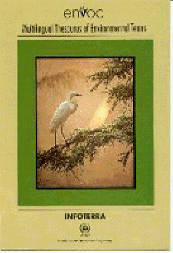
| II. The Importance of Using a Controlled Vocabulary What is a controlled vocabulary? Controlled vocabularies are used to facilitate the searching of websites or databases. When formulating a search query, controlled vocabularies, or pre-defined terminology, assist users by giving synonyms, preferred (controlled) usage terms, relationships among different terms and instructions. This is normally done through a thesaurus of descriptors. A thesaurus can be described as a controlled set of terms used to index information on a website or database, and to search for information stored on that website or database. Examples of established international thesauri are the Food and Agriculture's AGROVOC: Multilingual Agricultural Thesaurus (http://www.fao.org/agrovoc) and the United Nations Environment Programme's ENVOC: Multilingual Thesaurus of Environmental Terms. AGROVOC and ENVOC can be described as a multilingual thesaurus with a controlled and structured vocabulary for use in indexing, storing and retrieval of agricultural and environmental information. |
On 5 March 2002, during a
meeting in Montreal, technical experts offered advice to the Secretariat
on the use of controlled vocabularies: Use established vocabularies and
thesauri, when feasible, for such attributes as taxonomic names, geolocators,
subject matter, pathways and vectors, habitat types, organization names,
laws and regulations, and control methodologies. Encourage development
and use of multi-lingual thesauri. (UNEP/CBD/COP/6/INF/1/8) |
![]() |
The Clearing-House Mechanism has developed the CBD Controlled Vocabulary with the intent to provide the Secretariat with a list of terms to be used as descriptors, i.e., metadata (see Module 6), for web pages on the Convention's web site. The list can also be used by national CHMs to describe the contents of their national CHM web sites. In order to ensure its widest possible use, the CBD Controlled Vocabulary is based on ENVOC, AGROVOC and terms used in the Convention and other official documents. ENVOC and AGROVOC offer the additional benefit of presenting terminology in some of the official languages of the United Nations. Very often, these descriptors are referred to as metadata . The Clearing-House Mechanism will continue to develop common formats as recommended by the future meetings of the Conference of the Parties, the common format for national reporting adopted at the fifth meeting of the Conference of the Parties being a case in point (see decision V/19). |
![]() |
![]() |