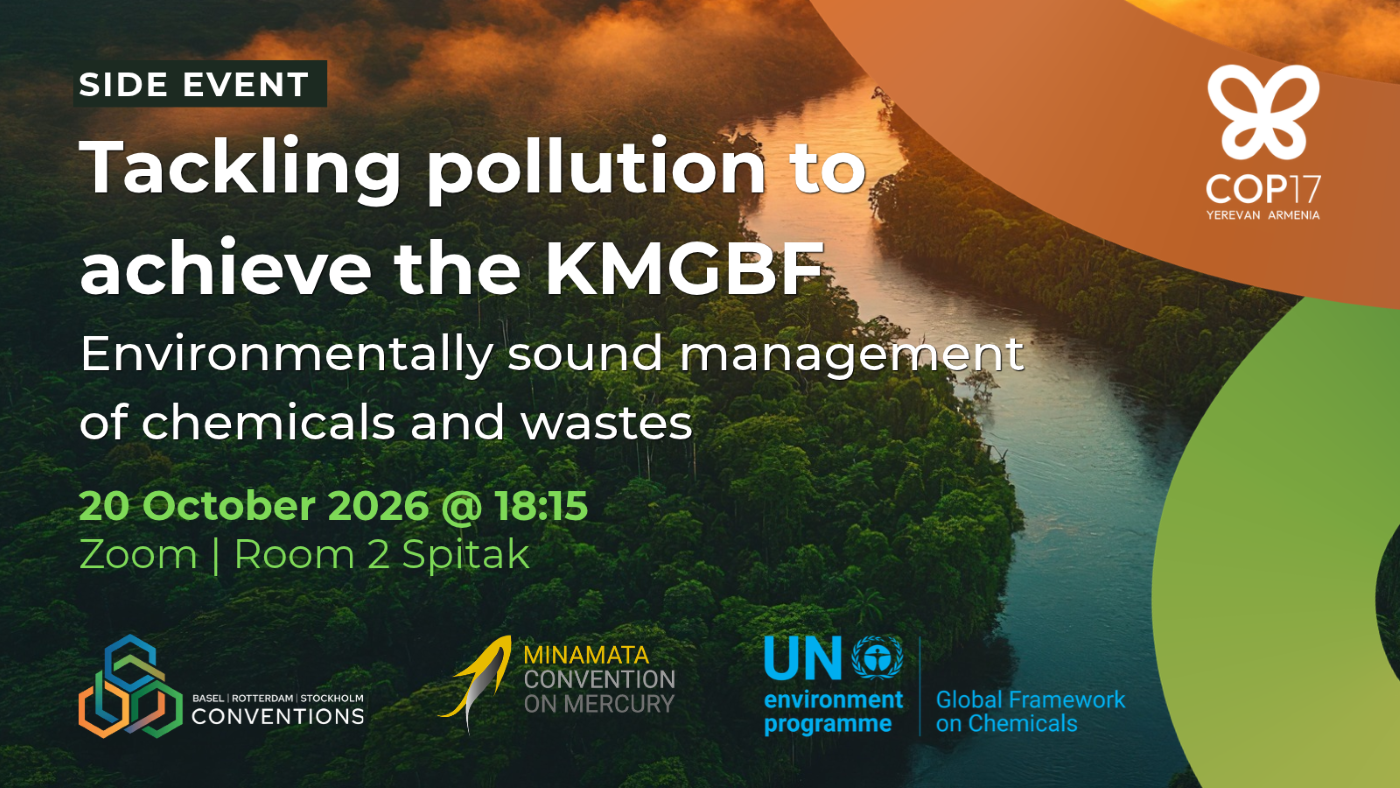
Pollution is one of the main direct drivers of biodiversity loss, threatening ecosystems, species, and human well-being
Achieving the goals and targets of the Kunming-Montreal Global Biodiversity Framework (KMGBF), particularly Target 7, requires effective action to prevent pollution and reduce its risks and impacts, alongside strengthened cooperation between biodiversity and chemicals and waste processes. Environmentally sound management of chemicals and wastes also supports ecosystem conservation and restoration, sustainable production and consumption, and human health.
This side event takes place at an important moment for advancing these connections. At COP 17, Parties will consider proposals on pollution and biodiversity, including approaches to strengthen scientific and technical support for implementing Target 7, as well as cooperation with relevant conventions, frameworks and scientific bodies. The draft proposals address pollution impacts across different ecosystems, the integration of biodiversity considerations into pollution prevention and control, and gaps in monitoring, tools and guidance.
Cooperation between biodiversity and chemicals and waste processes provides a practical foundation for this work. The report on the contributions of the Basel, Rotterdam and Stockholm conventions and the Global Framework on Chemicals to the KMGBF, together with work under the Minamata Convention, identifies opportunities to translate international commitments into mutually supportive national actions.
Monitoring programmes, national reporting systems and scientific networks under these instruments can provide valuable evidence for biodiversity policy and implementation. Greater exchange and use of existing information on hazardous chemicals and wastes can strengthen national assessments and help identify monitoring gaps. Such cooperation should improve the coherence and interoperability of information systems while respecting their different purposes and mandates.
Aligning National Biodiversity Strategies and actions plans on chemicals and waste management along other relevant national strategies can help countries address pollution pressures affecting biodiversity, coordinate institutions and identify shared implementation priorities.
This event will explore opportunities for fostering cooperation with international organizations and bodies established under the chemicals and waste conventions and other fora, providing an opportunity to advance coordinated implementation, capacity-building, information exchange and integrated financing, while respecting distinct mandates and avoiding duplication and additional reporting burdens.
The side event will showcase practical experiences of cooperation at global, regional and national levels. Representatives of countries and international organizations will discuss how coordinated policies, scientific collaboration, capacity-building, financing and monitoring can deliver benefits for biodiversity, pollution prevention and sustainable development.
Expected outcomes include practical recommendations for coordinated national implementation and international cooperation, better use of existing data and expertise, and stronger technical and financial support to accelerate progress towards Target 7 and related KMGBF targets.
Core Themes
1. Pollution prevention and mitigation as a contribution to KMGBF implementation
Highlighting how implementation of chemicals and waste instruments contributes to Target 7, ecosystem conservation and restoration, and other related KMGBF targets, in the context of the proposals before COP 17.
2. Coordinated national implementation and practical delivery
Exploring alignment of biodiversity and chemicals and waste plans, cooperation among national focal points and institutions, and technical and financial support for implementation, drawing on country and regional experiences.
3. Science, monitoring and information exchange
Identifying opportunities to use existing data, monitoring programmes and expertise more effectively, improve the coherence of information systems and address gaps in tools and guidance.
Target Audience
- CBD and chemicals and waste convention national focal points, policymakers and negotiators involved in KMGBF implementation and pollution-related agenda items.
- MEA secretariats, the GFC and United Nations entities and international organizations working on biodiversity, chemicals, waste and pollution.
- Regional centres, technical and scientific cooperation support centres, financing institutions and implementation partners.
- Researchers, civil society, Indigenous Peoples and local communities, women, youth and other stakeholders engaged in pollution prevention and biodiversity protection.
Objectives
The side event aims to:
- Showcase practical contributions of the BRS conventions, the Minamata Convention and the GFC to Target 7 and related KMGBF targets.
- Explore how national coordination, aligned plans and technical and financial support can translate these contributions into action.
- Identify opportunities for improved use of existing monitoring data, scientific expertise and reporting systems, without creating additional burdens.
- Develop practical recommendations and cooperation priorities relevant to the pollution and cooperation discussions at COP 17.
Expected Outcomes
A concise set of messages and priorities for coordinated national implementation, better use of existing evidence and expertise, and stronger technical and financial support. The discussion will help identify opportunities for follow-up among participating institutions, consistent with their mandates and the outcomes of COP 17.
| File |
Title & Description |
Tags |
|

|
Roadmap for enhancing co-benefits from implementation of the Minamata Convention and the Kunming-Montreal Global Biodiversity Framework
The sixth meeting of the Conference the Parties to the Minamata Convention on Mercury (COP-6)
welcomed this Road map for enhancing co-benefits from implementation of the Minamata Convention on
Mercury and the Kunming-Montreal Global Biodiversity Framework by 2030 in decision MC-6/18. The
annex to the document includes an overview of decisions taken by the Conference of the Parties to the
Convention on Biological Diversity at its sixteenth meeting that are of direct relevance to the Minamata
Convention.
Parties and other relevant stakeholders are encouraged, as appropriate, to carry out the actions
suggested in the Road map, on a voluntary basis, consistent with national priorities, circumstances and
capacities, and under the leadership of national Governments.
The three key pillars of the Road map for enhancing co-benefits from implementation of the Minamata
Convention and the Kunming-Montreal Global Biodiversity Framework and advancing overall coherence
across the mercury and biodiversity agendas are described below. While the focus of this document is on
the links between the implementation of the Minamata Convention and the Framework, the pillars would
also support coherence and synergies in the implementation of the Minamata Convention and the
Convention on Biological Diversity more generally.
The three pillars are: (i) contribution to the monitoring framework of the Kunming-Montreal Global
Biodiversity Framework, (ii) inclusion of mercury reduction actions and targets in NBSAPs and national
biodiversity targets; and (iii) creation of an enabling environment for enhanced co-benefits, including
resource mobilization, capacity-building and cooperation.
Roadmap-Minamata-Biodiversity_EN.pdf
|
#minamata #mercury #pollution #GBF #KMGBF #biodiversity #makemercuryhistory
|
|

|
Report on the contributions of the chemicals and waste international agreements and frameworks to the Kunming-Montreal Global Biodiversity Framework
The report examines how the Basel, Rotterdam and Stockholm conventions and the Global Framework on Chemicals contribute to achieving the goals and targets of the Kunming-Montreal Global Biodiversity Framework. It aims to raise awareness of the links between chemicals, waste and biodiversity, and identify opportunities for stronger cooperation and coordinated implementation. While emphasizing Target 7 on reducing pollution, it demonstrates how sound chemicals and waste management supports a broad range of biodiversity objectives.
Organized around relevant biodiversity targets, the report presents key interlinkages, existing initiatives and practical opportunities for further action across six themes: pollution impacts on ecosystems and species; sustainable production and consumption; knowledge and capacity; management and conservation; gender and social justice; and financing. It highlights how existing instruments, technical guidance, partnerships and implementation mechanisms can support biodiversity action, and identifies next steps to strengthen national implementation and collaboration across sectors.
Report-on-the-contributions-of-BRS-conventions-and-the-GFC-to-the-KM-GBF.pdf
|
Biodiversity, Pollution, GlobalBiodiversityFramework, chemicals, waste, hazardous, conventions, UNEP, BRS, Stockholm, Basel, Rottedam, GFC, Target7, GBF
|
|

|
report Interlinkages between the chemicals and waste multilateral environmental agreements and biodiversity: Key insights
This report examines how the Basel, Rotterdam, Stockholm and Minamata conventions contribute to biodiversity conservation and sustainable use. Published in 2021 to inform the development of the post-2020 global biodiversity framework, it aims to strengthen understanding of the links between pollution and biodiversity loss and identify opportunities for closer cooperation between chemicals and waste agreements and biodiversity-related instruments.
The report presents key findings on the impacts of mercury, persistent organic pollutants, pesticides, and hazardous and other wastes on species, ecosystems and nature’s contributions to people. It describes relevant measures under the four conventions, links their implementation to global sustainable development objectives, and highlights challenges and emerging issues. It also identifies opportunities for joint action, including improved monitoring and information exchange, coordinated work on pollution targets and indicators, and collaboration on plastics, electronic waste, artisanal and small-scale gold mining, and pesticide impacts on pollinators.
UNEP-FAO-CHW-RC-POPS-MC-PUB-BiodiversityInterlinkagesKeyInsights.English-(1).pdf
|
MEAS, convention, pollution, chemicals, interlinkages, synergies, biodiversity, waste, pollutants, POPs, mercury, hazardous
|
| File |
Title & Description |
Tags |
|

|
The Basel Convention on the control of the transboundary movements of hazardous wastes and their disposal
This Convention protects human health and the environment from the adverse effects of hazardous and other wastes by minimizing their generation, controlling their transboundary movements and ensuring their environmentally sound management.
|
#chemicalsandwaste #makevisibletheinvisible #BRS #BaselConvention #hazardouswaste #waste #pollution #
|
|

|
The Stockholm Convention on Persistent Organic Pollutants
This Convention protects human health and the environment from persistent organic pollutants by eliminating or restricting their production and use, reducing or eliminating releases, and ensuring the environmentally sound management of related wastes.
|
stockholm, MEAs, POPs, pollutants, pollution, chemicals, hazardous, waste
|
|

|
Rotterdam Convention
Promotes shared responsibility and cooperation in the international trade of certain hazardous chemicals and pesticides through information exchange and a prior informed consent procedure, helping countries make informed import decisions.
|
MEAS, Rotterdam, convention, trade, chemicals, industrial, pesticides, pollution, hazardous, RiskAssessment
|
|

|
The Global Framework on Chemicals (GFC)
The Global Framework on Chemicals - For a Planet Free of Harm from Chemicals and Waste (GFC), provides the essential building blocks for a future in which humanity benefits from chemicals in a safe and sustainable manner, while avoiding their negative impacts.
The Framework, adopted in September 2023 at the fifth International Conference on Chemicals Management (ICCM5), seeks to protect both the planet and human health, advocating for strong governance mechanisms and promoting international standards.
The Framework presents a comprehensive plan with five strategic objectives and 28 targetsto guide countries and stakeholders in jointly addressing the lifecycle of chemicals, including products and waste.
This unique multi-stakeholder agreement brings in a variety of sectors including representatives from governments, the private sector, non-governmental and intergovernmental organizations, youth and academia.
It is supported by the Bonn Declaration, a high-level declaration also agreed at ICCM5 in Bonn, Germany.
global-framework-chemicals
|
GFC, framework, chemicals, waste, international, cooperation,
|
|

|
The Minamata Convention on mercury
This Convention protects human health and the environment from anthropogenic emissions and releases of mercury and mercury compounds by addressing mercury throughout its life cycle, including its supply, trade, use, emissions, releases and waste management.
en
|
MEA, convention, Minamata, Mercury, pollution
|
| File |
Title & Description |
Tags |
|
|
|
|
|