

Background on the EBSA Process
The EBSAs are special areas in the ocean that serve important purposes, in one way or another, to support the healthy functioning of oceans and the many services that it provides.
 The ocean is under increasing threat from various human activities. The most pressing threats come from overfishing, destructive fishing practices, and illegal, unreported and unregulated fishing activities. Other emerging problems include marine debris, ship-based marine pollution, transfer of alien invasive species, illegal dumping and the legacy of historical dumping, seabed mineral extraction, and noise pollution.
The combined impacts of these threats as well as the potential impacts of climate change and ocean acidification have placed thousands of species at risk of extinction, and have impaired the structure, function, productivity and resilience of marine ecosystems.
At the present time, the world's oceans are seriously underprotected, with only approximately 0.8% of the oceans and 6% of territorial seas being within protected area systems. Measures are being taken to increase protection and sustainable management. In order to support effective policy action by countries and competent international and regional organizations, it is critical to build a sound understanding of the most ecologically and biologically important ocean areas that support healthy marine ecosystems.
Scientific Criteria for Identifying Ecologically or Biologically Significant Marine Areas (EBSAs)
In 2008, the ninth meeting of the Conference of the Parties to the Convention on Biological Diversity (COP 9) adopted the following scientific criteria for identifying ecologically or biologically significant marine areas in need of protection in open-ocean waters and deep-sea habitats.
For more details on the EBSA criteria, please see: cbd.int/doc/meetings/mar/ebsaws-2014-01/other/ebsaws-2014-01-azores-brochure-en.pdf
CBD scientific criteria for ecologically or biologically significant areas (EBSAs) (annex I, decision IX/20)
- Uniqueness or Rarity
- Special importance for life history stages of species
- Importance for threatened, endangered or declining species and/or habitats
- Vulnerability, Fragility, Sensitivity, or Slow recovery
- Biological Productivity
- Biological Diversity
- Naturalness
Application of Scientific Criteria for EBSAs
In 2010, COP 10 noted that the application of the EBSA criteria is a scientific and technical exercise, that areas found to meet the criteria may require enhanced conservation and management measures, and that this can be achieved through a variety of means, including marine protected areas and impact assessments. The COP further noted that the application of the EBSA criteria is an open and evolving process that should be continued to allow ongoing improvement and updating as improved scientific and technical information becomes available in each region.
Who Identifies EBSAs
COP 10 emphasized that the identification of EBSAs and the selection of conservation and management measures is a matter for States and competent intergovernmental organizations, in accordance with international law, including the UN Convention on the Law of the Sea.
Dataset for Identifying EBSAs
COP 10 emphasized that identification of EBSAs should use the best available scientific and technical information and integrate the traditional, scientific, technical, and technological knowledge of indigenous and local communities, and requested the Executive Secretary to facilitate availability and interoperability of the best available marine and coastal biodiversity data sets and information across global, regional and national scales.
Scientific Description of EBSAs at the Regional Level
COP 10 requested the Executive Secretary to organize a series of regional workshops with a primary objective to facilitate the description of EBSAs through application of scientific criteria as well as other relevant compatible and complementary nationally and intergovernmentally agreed scientific criteria, as well as the scientific guidance for the application of EBSA criteria.
Consideration by COP of the Report on Description of Areas Meeting EBSA Criteria and Submission of the Report to UNGA Processes
COP 10 requested the Subsidiary Body on Scientific, Technical and Technological Advice (SBSTTA) to prepare reports based on scientific and technical evaluation of information from the regional workshops, setting out details of areas that meet the scientific criteria for consideration in a transparent manner by the Conference of the Parties to the Convention, with a view to include the report in the repository and submit the report to the United Nations General Assembly (UNGA), particularly the Ad Hoc Open ended Informal Working Group, as well as relevant international organizations, Parties and other Governments.
Cooperation on Managing Areas Meeting EBSA Criteria
COP 10 encouraged Parties, other Governments and competent intergovernmental organizations to cooperate collectively or on a regional or subregional basis, to identify and adopt appropriate measures for conservation conservation and sustainable use in relation to EBSAs, including by establishing representative networks of marine protected areas in accordance with international law, including the United Nations Convention on the Law of the Sea, and based on best scientific information available, and to inform the relevant processes within the UNGA.
Regional Workshops to Facilitate Description of Areas Meeting EBSA Criteria
Pursuant to the request by COP 10, the Executive Secretary has convened a series of regional workshops in the following regions:
- Western South Pacific Ocean
- Wider Caribbean & Western Mid-Atlantic Ocean
- Southern Indian Ocean
- Eastern Tropical & Temperate Pacific Ocean
- North Pacific Ocean
- South-Eastern Atlantic Ocean
- Arctic Ocean
- North-West Atlantic Ocean
- Mediterranean Sea
- North-West Atlantic Ocean
- North-East Indian Ocean
- North-West Indian Ocean and Adjacent Gulf Areas
- East Asian Seas
- Black and Caspian Seas
- Baltic Sea
- North-East Atlantic and Adjacent Areas
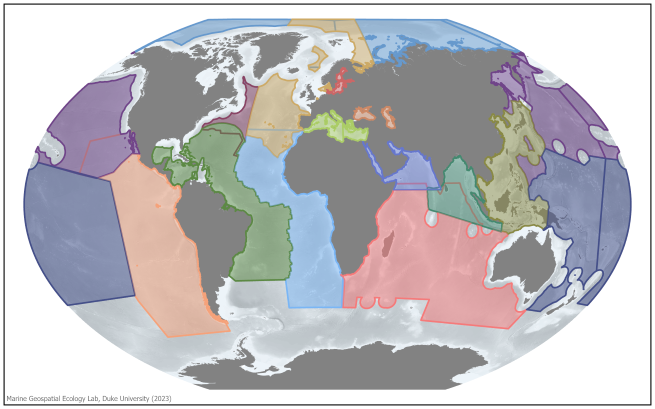
The geographical scope of the 15 regional workshop areas organized by the CBD Secretariat to facilitate the description of areas meeting the EBSA criteria, to date.