 IISD/ENB | Mike Muzurakis
Parties to the Convention on Biological Diversity advance key implementation enablers ahead of a decisive COP 17 in October
PRESS RELEASE
First milestone in a marathon year of biodiversity negotiations reached
Parties to the Convention on Biological Diversity advance key implementation enablers ahead of a decisive COP 17 in October
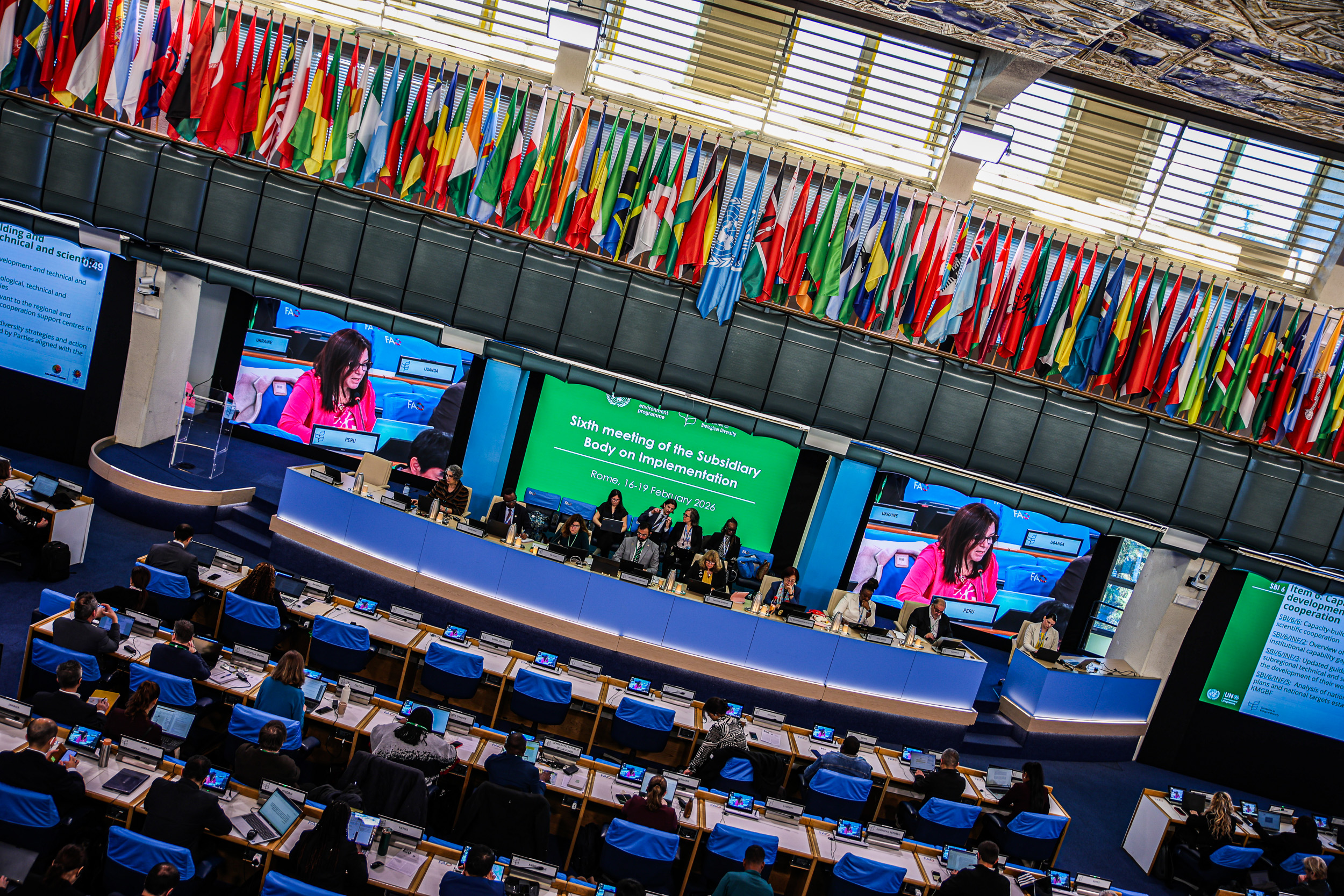
Rome, 19 February 2026 — The sixth meeting of the Subsidiary Body on Implementation (SBI-6) concluded today in Rome, with broad agreement among the Parties to the Convention on Biological Diversity (CBD) around key enablers to implement the Kunming-Montreal Global Biodiversity Framework (KMGBF). The aspects addressed included biodiversity finance, progress in the implementation of the Gender Plan of Action, capacity-building and development, cooperation with international organizations and other conventions, and the fair and equitable sharing of benefits arising from the use of genetic resources.
The recommendations adopted by the Subsidiary Body will be considered for adoption at the 2026 United Nations Biodiversity Conference, hosted by Armenia in Yerevan from 19-30 October 2026. The Conference, comprising the 17th meeting of the Conference of the Parties (COP17) and meetings of the Convention’s Cartagena and Nagoya Protocols, will see the first global review of collective progress in the implementation of the KMGBF.
In many of the adopted recommendations, Party negotiators were able to produce bracket-free, clean text, signaling commitment to securing consensus in Yerevan. “The conclusion of SBI-6 marks the achievement of an important first milestone in a marathon year,” said Clarissa Nina, the Chair of SBI. “I thank the Parties for working together in a spirit of solidarity and common purpose to iron out divergences and deliver these robust recommendations.”
Parties re-committed to finalizing National Biodiversity Strategies and Action Plans (NBSAPs), National Targets, and National Reports as soon as possible. There is a 28 February deadline for national reports as inputs into this year’s global review of collective progress, with their inclusion being important to provide an evidence-based assessment of where the world stands on halting and reversing biodiversity loss. An analysis covering 130 sets of national targets and 51 NBSAPs, which informed the deliberations at the meeting, revealed a gap between the global ambition of the KMGBF and what Parties have set out to achieve at the national level. “These insights also highlight the possibility of correcting course by increasing ambition and accelerating implementation at the national level,” said Astrid Schomaker, Executive Secretary of the CBD. Since the analysis, a further 20 NBSAPs have been submitted.
By the time the meeting closed, the European Union, Lesotho, Uganda and Switzerland were announced as the first Parties to have submitted their 7th National Reports ahead of the 28 February deadline. Several Parties indicated their intention to follow suit, while others pointed to difficulties linked to capacity gaps and limited or delayed access to resources. All other actors were also encouraged to submit information, including indigenous peoples and local communities, civil society, women, youth, the private sector and academia.
Up to now, 75 percent of Parties have submitted national targets. These constitute the actual drivers of national implementation and are tethered into the monitoring and review mechanisms -- which makes them crucial for the global review at COP 17 and for responsibility and transparency in the implementation of the 23 targets of the KMGBF.
Due to a shortage of funding for the participation of delegates from developing countries, several single-member delegations faced considerable challenges in keeping pace with the intensive nature of the negotiations during the four-day meeting. Thanking Austria, Canada, Denmark, Finland, Ireland, Germany, Monaco, Netherlands, Sweden, Poland, Spain, and Switzerland for their contributions to the dedicated Trust Fund, the Executive Secretary reiterated her call on other eligible donors to “step forward and support inclusive participation in a year of taking action for nature.”
*******************
NOTES TO EDITORS
A summary of the analysis of national submissions mentioned in the press release is offered in Section III of the pre-session document.
To keep track of submissions of NBSAPs and National Targets, National Reports and actors other than national Governments: refer to the Online Reporting Tool (ORT): https://ort.cbd.int
Learn more about submissions by actors other than national governments: https://www.cbd.int/article/2025-submissions-actors-other-than-national-governments
About SBI: In 2016 The Conference of the Parties to the Convention on Biological Diversity established the Subsidiary Body on Implementation (SBI) to replace the Ad Hoc Open-ended Working Group on Review of Implementation of the Convention. The four functions and core areas of work of SBI consist of: (a) review of progress in implementation; (b) strategic actions to enhance implementation; (c) strengthening means of implementation; and (d) operations of the convention and the Protocols.
About the KMGBF: The Kunming-Montreal Global Biodiversity Framework (KMGBF) was adopted during the fifteenth meeting of the Conference of the Parties (COP 15) following a four year consultation and negotiation process. This historic Framework, which supports the achievement of the Sustainable Development Goals and builds on the Convention’s previous Strategic Plans, sets out an ambitious pathway to reach the global vision of a world living in harmony with nature by 2050. Among the Framework’s key elements are four goals for 2050 and 23 targets for 2030.