Long-Term Strategic Framework for Capacity-Building and Development
The fifteenth meeting of the Conference of the Parties (COP 15) adopted in Annex I of decision 15/8 a long-term strategic framework for capacity-building and development to support nationally determined priorities for the implementation of the Kunming-Montreal Global Biodiversity Framework (KMGBF).
The long-term strategic framework, further elaborated in document CBD/SBI/3/7/Add.1, outlines the expected high-level capacity results; provides a menu of guiding principles, key strategies and approaches for improving the design, implementation, monitoring and evaluation of capacity-building and development initiatives and programmes; and describes mechanisms to facilitate and support its implementation at the global, regional and country level.
Overarching Guiding Principles
- Inclusive analysis of existing capacities and needs is essential to ensure effective capacity-building and development (CB&D) interventions.
- Country ownership and commitment should be cornerstones for CB&D actions.
- Strategic and integrated system-wide approaches to CB&D should be promoted.
- Interventions should be designed and implemented according to recognized good practice and lessons learned.
- Indigenous peoples and local communities, gender and youth perspectives should be fully integrated into biodiversity CB&D efforts taking into account the Gender Plan of Action.
- Monitoring and evaluation, and learning frameworks should be incorporated into CB&D strategies, plans and programmes from the start.
Key Strategies to Improve Capacity-Building and Development
- Institutionalize capacity-building and development (CB&D)
- Integrate long-term CB&D into NBSAPs
- Increase focus on life-long learning
- Align biodiversity CB&D with broader cross-sectoral plans and programmes
- Undertake measures to fully utilize and retain existing capacity
- Develop thematic and regional (and/or subregional) CB&D action plans and programmes
- Promote partnerships and networks for implementation
- Enhance synergies between CB&D efforts of relevant processes
- Promote North-South cooperation
- Promote South-South and triangular cooperation
- Engage the private sector
- Strengthen monitoring and evaluation of CB&D interventions
Mechanisms for Implementation of Capacity-Building and Development
- Governance and coordination mechanisms
- Mutual supportiveness between various implementation strategies and processes
- Resource mobilization for capacity-building and development
- Regional and global support networks
- Enhanced review mechanisms
- Outreach and dissemination of the long-term strategic framework
- Reporting and review of the long-term strategic framework
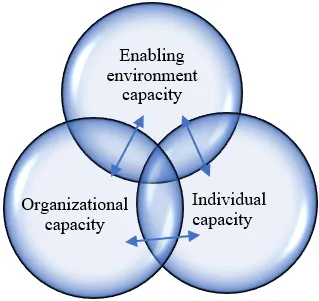
Relationship between levels of capacity
Expected Capacity Results
Long-term, high-level outcomes
- Successful implementation of NBSAPs
- Achievement of 2030 targets and 2050 vision of the KMGBF
- Biodiversity mainstreamed throughout sectors and society
- Strengthened access to and transfer of technology and effective participation in technical and scientific cooperation, particularly for developing countries
Medium-term outcomes
- Successful development and update of NBSAPs
- Sound enabling frameworks and institutional arrangements support the achievement of NBSAPs
- Strategic partnerships and learning networks enhance biodiversity conservation and sustainable use efforts along with the equitable sharing of benefits arising from the utilization of genetic resources
- High-quality programmes and projects that are technically sound, have realistic and achievable plans, address gender and youth considerations, and embed monitoring
- Effective monitoring and evaluation and learning processes embedded into projects and programmes to support decision-making at all levels
- Reinforcing mechanisms, incentive structures and investments ensure utilization and retention of capacity at all levels