| ID | 5286 | 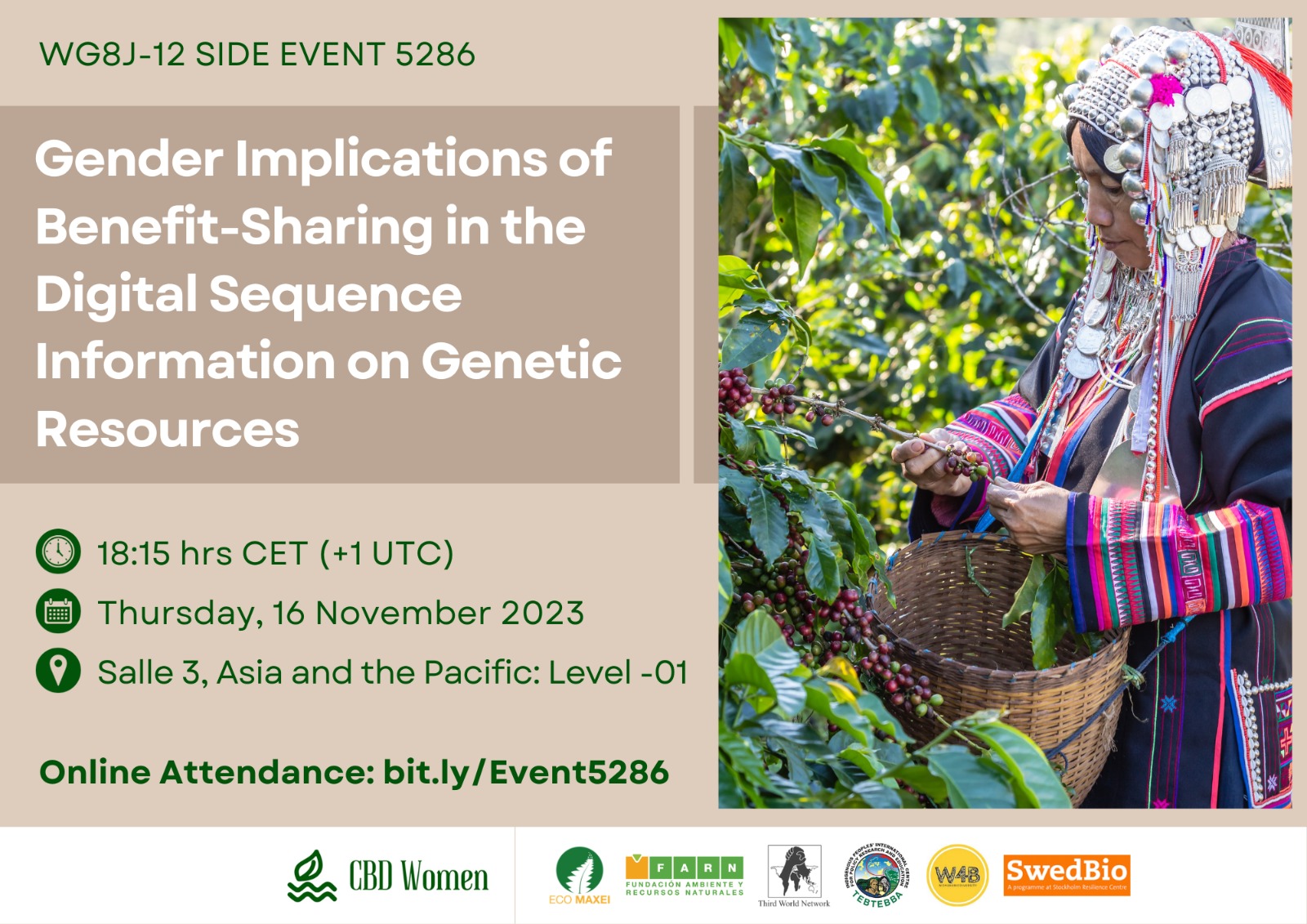 |
||||||||||||||||||||||||
|---|---|---|---|---|---|---|---|---|---|---|---|---|---|---|---|---|---|---|---|---|---|---|---|---|---|---|
| Date |
Thursday 2023.11.16 @ 18:15 Add to Calendar |
|||||||||||||||||||||||||
| Room | Salle 3 - Asia and the Pacific Level -1 Capacity: 70 people |
|||||||||||||||||||||||||
| Conference | WG8J-12 / WGDSI-01 |
|||||||||||||||||||||||||
| Meetings(s) | WGDSI-01 First meeting of the Ad Hoc Open-ended Working Group on Benefit-sharing from the Use of Digital Sequence Information on Genetic Resources |
|||||||||||||||||||||||||
| Title | Gender Implications of Benefit-Sharing in the Digital Sequence Information on Genetic Resources | |||||||||||||||||||||||||
| Hosts |
CBD Women Caucus |
Eco maxei |
FARN |
TWN |
W4B |
SwedBio |
|
|||||||||||||||||||||||||
| Topics |
Indigenous peoples and local communities Nagoya Protocol on Access and Benefit-sharing Cartagena Protocol on Biosafety Kunming-Montreal Global Biodiversity Framework Implementation of the Convention on Biological Diversity Financial Mechanism and Resources Mobilization Access to Genetic Resources and Benefit-sharing Gender and Biodiversity Traditional Knowledge, Innovations and Practices Genetic Use Restriction Technologies
|
|||||||||||||||||||||||||
|
|
||||||||||||||||||||||||||
|
Rationale: In the rapidly evolving landscape of genetic resource use, the intersection of gender dynamics and benefit-sharing mechanisms is a critical but often overlooked aspect. The Convention on Biological Diversity (CBD) and the Nagoya Protocol have laid the legal foundations for access to genetic resources and the equitable sharing of benefits, but the implications of these decisions for gender equity require closer examination. Decision 15/9 highlights the complexity surrounding digital sequence information on genetic resources (DSI) and the divergent views on its scope under the CBD. It recognises the potential of DSI to support research, innovation and sustainable development, while emphasising the importance of capacity building and development. In this context, it is important to address the gender implications of benefit-sharing in DSI to ensure that women and girls, particularly those from Indigenous peoples and local communities are not left behind in the pursuit of biodiversity conservation. In addition, the decision recognises the value of depositing data in public databases, highlighting the need for transparent and inclusive governance models, as emphasised in the FAIR and CARE principles. The decision also recognises that a benefit-sharing solution may include innovative revenue generation measures, highlighting the monetary and non-monetary aspects; and those indeed could influence gender dynamics. The diversity of views on the concept and scope of DSI requires an inclusive discussion that takes into account the perspectives of women and Indigenous peoples and local communities, who may have different experiences and rights related to genetic resources. Decision 15/9 sets the stage for the establishment of a multilateral mechanism for benefit-sharing from the use of DSI, including a global fund, under the Kunming-Montreal Global Biodiversity Framework. Along with this multilateral mechanism, countries may also carve out space for bilateral or hybrid systems. This provides an opportune moment to examine how both these approaches this mechanism can be gender-responsive and contribute to the participation and empowerment of women in biodiversity research and use. By shedding light on the gender dimensions of DSI benefit-sharing, this event aims to inform policies, strategies and recommendations that promote inclusivity, equity and women's active participation in the evolving landscape of genetic resources management and conservation. It aligns with the broader goals of the CBD and the Nagoya Protocol to promote sustainable development and protect biodiversity, while ensuring that gender considerations remain central to these objectives. Objectives: To raise awareness of gender inequalities and opportunities related to DSIs To analyse the potential impact of benefit-sharing mechanisms on women's participation and empowerment in biodiversity research and use. To discuss policy options and recommendations to promote gender-responsive benefit-sharing in DSI activities. Target Audience: The Roundtable welcomes the active participation of a diverse audience, including rights-holders, experts, policy-makers, practitioners and advocates interested in the intersection of gender justice and biodiversity conservation. Format: - Panel discussion format followed by a Q&A session - Translation (English/Spanish/French) will be provided - Live graphical coverage (tbc) - Live webcast (tbc) - Catering (tbc) Key topics to be covered: This side event will facilitate a broad discussion on gender aspects of benefit-sharing in the context of DSI, with the aim of informing policy recommendations and promoting inclusive and equitable practices in biodiversity management and research. How can we ensure that women have equal opportunities to access and contribute to DSI activities? What are the potential barriers and opportunities for women from Indigenous peoples and local communities to benefit from DSI? What strategies and best practices can be adopted to promote women's leadership and participation in DSI research and utilisation? How can benefit-sharing mechanisms from DSI activities contribute to women's empowerment and support gender equality in biodiversity conservation efforts?
Error as occured...
Error as occured...
Error as occured...
Error as occured...
|
||||||||||||||||||||||||||
| Documents |
|
|||||||||||||||||||||||||

