| ID | 6709 | 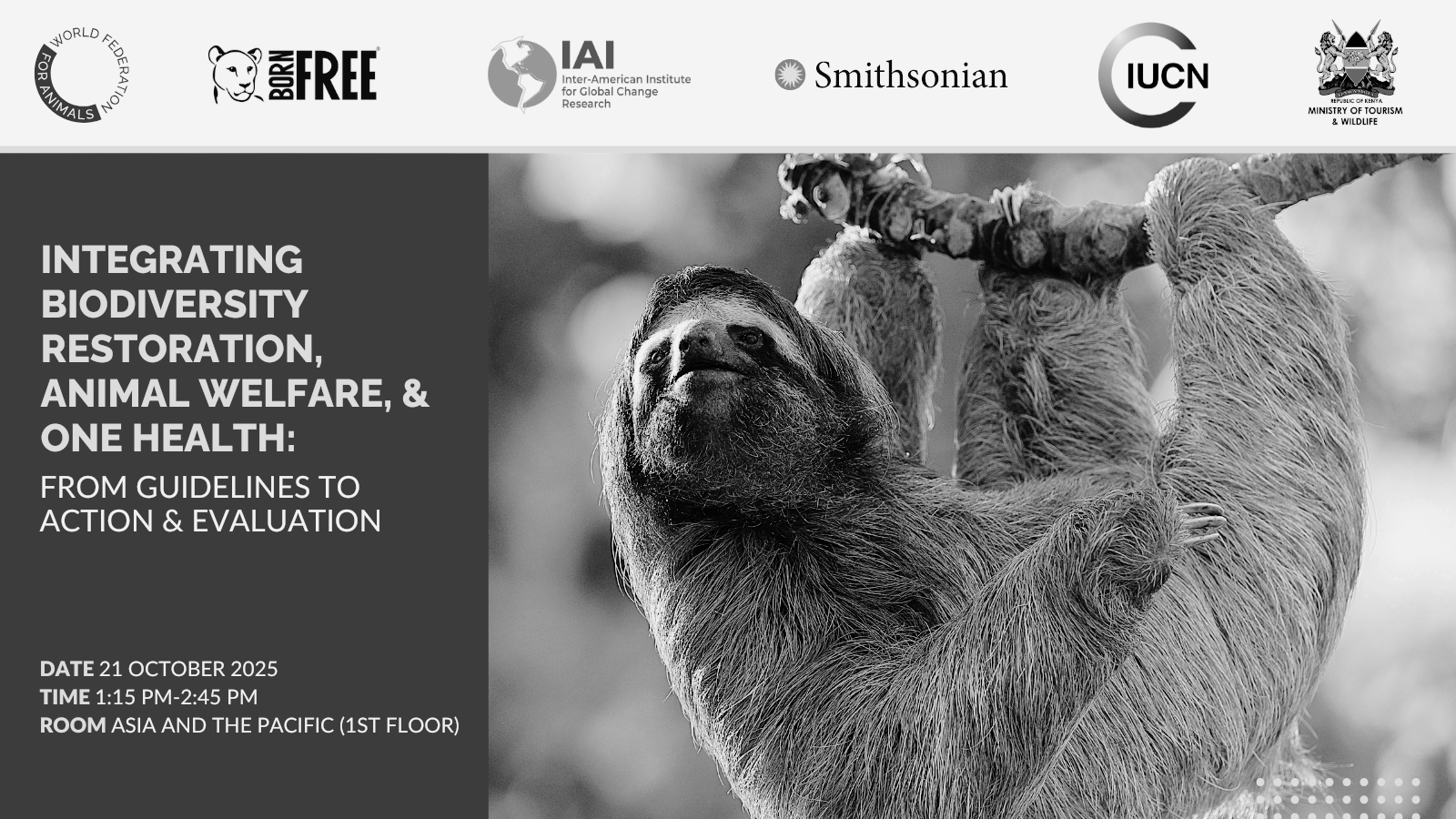 |
||||||||||||||||||||||||
|---|---|---|---|---|---|---|---|---|---|---|---|---|---|---|---|---|---|---|---|---|---|---|---|---|---|---|
| Date |
Tuesday 2025.10.21 @ 13:15 Add to Calendar |
|||||||||||||||||||||||||
| Room | Asia and the Pacific 2nd floor Capacity: 80 people |
|||||||||||||||||||||||||
| Conference | SBSTTA-27 and SB8J-01, 20 - 30 October 2025 |
|||||||||||||||||||||||||
| Meetings(s) | SBSTTA-27 Twenty-seventh meeting of the Subsidiary Body on Scientific, Technical and Technological Advice |
|||||||||||||||||||||||||
| Title | Integrating Biodiversity Restoration, Animal Welfare, and One Health: From Guidelines to Action and Evaluation | |||||||||||||||||||||||||
| Hosts |
IAI |
BFF |
WFA |
SI |
IUCN SSC CTSG |
MOTW |
IUCN Forests and Grasslands |
|
|||||||||||||||||||||||||
| Topics |
Kunming-Montreal Global Biodiversity Framework Indicators Capacity-building and Development Scientific and Technical Cooperation Health and Biodiversity
|
|||||||||||||||||||||||||
|
|
||||||||||||||||||||||||||
|
At COP16, Parties adopted the Global Action Plan on Biodiversity and Health (GAPBH) under Decision 16/19, reinforcing the integration of biodiversity, climate, and health within the Kunming-Montreal Global Biodiversity Framework (KMGBF). This side event will showcase complementary approaches that strengthen science-policy interfaces and support national implementation of the Framework. Building on regional experiences across the Americas, the Inter-American Institute for Global Change Research (IAI) will highlight lessons from its Climate-Environment-Health transdisciplinary science program with multilateral projects implemented in 15 countries. The IAI will also present a forthcoming project to advance science and technical cooperation in the region for the development of harmonized environmental indicators that link Human Health and Biodiversity through a One Health approach, including the use of satellite image analysis, to support the implementation of the GAPBH. Complementing this perspective, the Born Free Foundation and the World Federation for Animals will preview and invite stakeholders to engage in the development of new guidance to support governments in translating the GAPBH into practical measures. This tool combines policy recommendations, case studies, and best practices to demonstrate how addressing animal health and welfare can deliver co-benefits for biodiversity conservation, food systems, zoonotic disease prevention, antimicrobial resistance, and biodiversity-climate-health synergies. The Smithsonian Institution and IUCN partners will focus on how wildlife conservation translocations contribute directly to KMGBF Targets 2 and 4, yet current monitoring frameworks often overlook their interlinkages with One Health and with conservation and restoration goals. Positive examples will be shared, including the IUCN Conservation Translocation Specialist Group guidelines on responsible translocations of displaced organisms, which link wildlife health, welfare, and conservation, paving the way for more integrated approaches that strengthen health dimensions in conservation. In Kenya, collaborative work with partners is exploring which available wildlife data could be translated into national indicators, providing an example of how science-based guidance can strengthen policy. By bringing together governments, scientists, and civil society, this session will explore how harmonized indicators, One Health approaches linking human, animal, and environmental well-being, and species restoration can collectively accelerate implementation of the GAPBH and the KMGBF by moving from guidance to action and fostering evaluation.
Error as occured...
Error as occured...
Error as occured...
Error as occured...
|
||||||||||||||||||||||||||
| Documents |
|
|||||||||||||||||||||||||

