| ID | 6776 | 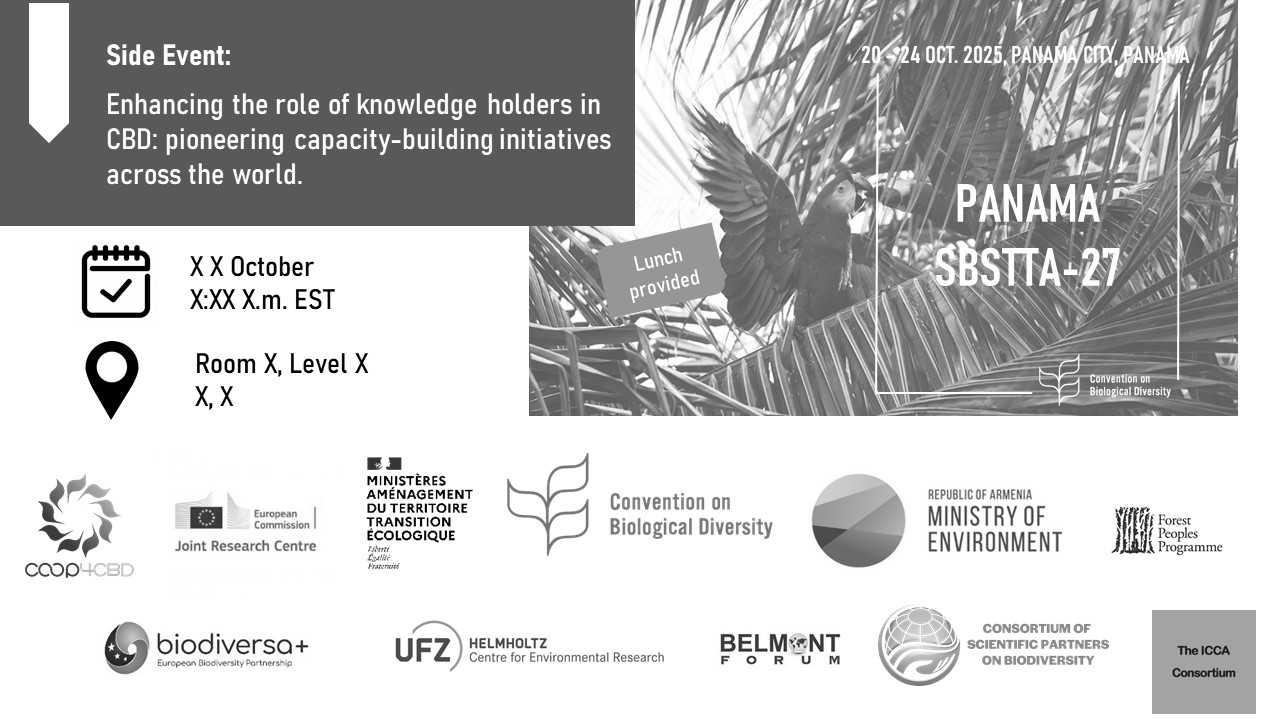 |
||||||||||||||||||||||||
|---|---|---|---|---|---|---|---|---|---|---|---|---|---|---|---|---|---|---|---|---|---|---|---|---|---|---|
| Date |
Friday 2025.10.24 @ 13:15 Add to Calendar |
|||||||||||||||||||||||||
| Room | NGOs Group meeting room Ground floor Capacity: 74 people |
|||||||||||||||||||||||||
| Conference | SBSTTA-27 and SB8J-01, 20 - 30 October 2025 |
|||||||||||||||||||||||||
| Meetings(s) | SBSTTA-27 Twenty-seventh meeting of the Subsidiary Body on Scientific, Technical and Technological Advice |
|||||||||||||||||||||||||
| Title | Enhancing the role of knowledge holders in CBD: pioneering capacity-building initiatives across the world. | |||||||||||||||||||||||||
| Hosts |
CO-OP4CBD |
(Biodiversa+) |
MTE |
European Commission Joint Research Center |
BF |
SCBD |
FPP |
ICCA Consortium |
CSP |
MNHN |
FRB |
UNEP-WCMC |
|
|||||||||||||||||||||||||
| Topics |
Secretariat of the Convention on Biological Diversity Subsidiary Body on Scientific, Technical and Technological Advice (SBSTTA) Planning Kunming-Montreal Global Biodiversity Framework Reporting Indicators Implementation of the Convention on Biological Diversity Capacity-building and Development Clearing-House Mechanism Indigenous peoples and local communities Knowledge Management Scientific and Technical Cooperation Traditional Knowledge, Innovations and Practices Exchange of Information Communication, Education and Public Awareness
|
|||||||||||||||||||||||||
|
|
||||||||||||||||||||||||||
|
Scientific cooperation and science driven policy making are ones of the main objectives of the Convention, as stated in article 16, 17 and 18 and today in the Targets 20 & 21 of the KM-GBF. Parties are also asking for constant scientific and technical inputs, as it is instrumental to help the implementation of the objectives of the Convention, its protocols and the KM-GBF. The item 6 of the SBSTTA27 meeting highlights that need, asking for information and knowledge to define Convention programmes of work, as well as identifying new issues that could be tackled by the Parties. However, significant knowledge gaps remain in the CBD context and the application of scientific (incl. both academic and Indigenous) findings in decision-making, and policy implementation is not yet fully realised. In a way, despite increasing efforts to ensure that decisions are based on science, it is still difficult to find a real space for this knowledge to emerge in discussions. In order to overcome this specific challenge, initiatives all around the world are trying to complete the work already carried out by science-policy platforms by making the knowledge really accessible to decision-makers, as requested by the KM-GBF Target 21. In Europe, the European Biodiversity Partnership Biodiversa+ as well as the CO-OP4CBD project are building capacities of biodiversity experts – scientists, but also indigenous and local knowledge holders – so that they can effectively engage with CBD actors or in the Convention’s processes. The Belmont Forum complements these efforts by advancing capacity building, transdisciplinary research and open data to bridge knowledge systems and support evidence-informed policy aligned with the CBD. Several other projects are more specifically fostering the engagement of knowledge holders in IPBES, one of the major actors providing evidence to the CBD: CABES, in Africa, and RESPIN, in Europe (Future Earth etc.). Moreover, the new Technical and Scientific Centers (TSCCs) recently set up will help gathering knowledge, as well as capacity building resources and initiatives to make this science and policy interface more effective. Targeting national delegates, and other stakeholders, who may be familiar or not with the science-policy interface, this side event will showcase successful capacity-building programmes, sharing tools, methods, and good practices to reinforce those initiatives and build a strong network among CBD Parties. Among the activities that will be presented, Biodiversa+ and CO-OP4CBD will showcase a guide specifically framed to provide concrete tools for the knowledge holders and the experts to engage in the CBD process. The guide offers a comprehensive toolbox of ways to gradually participate in the work of the CBD, from understanding the CBD strategic decisions to developing a joint research project with the CBD Secretariat. Using concrete examples, this event will show how we could improve the science-policy interface in the context of the CBD.
Error as occured...
Error as occured...
Error as occured...
Error as occured...
|
||||||||||||||||||||||||||
| Documents |
|
|||||||||||||||||||||||||


