Error as occured...

Side Event #6928

Status: PUBLISHED

Date Monday
2026.07.27 @ 18:15
Add to Calendar
Room CR-9 - Group of African States meeting room
2nd floor
Capacity: 80 people
Conference SBSTTA-28 / SBI-07, 27 July to 12 August 2026
Meetings(s)
SBSTTA-28
Twenty-eighth meeting of the Subsidiary Body on Scientific, Technical and Technological Advice
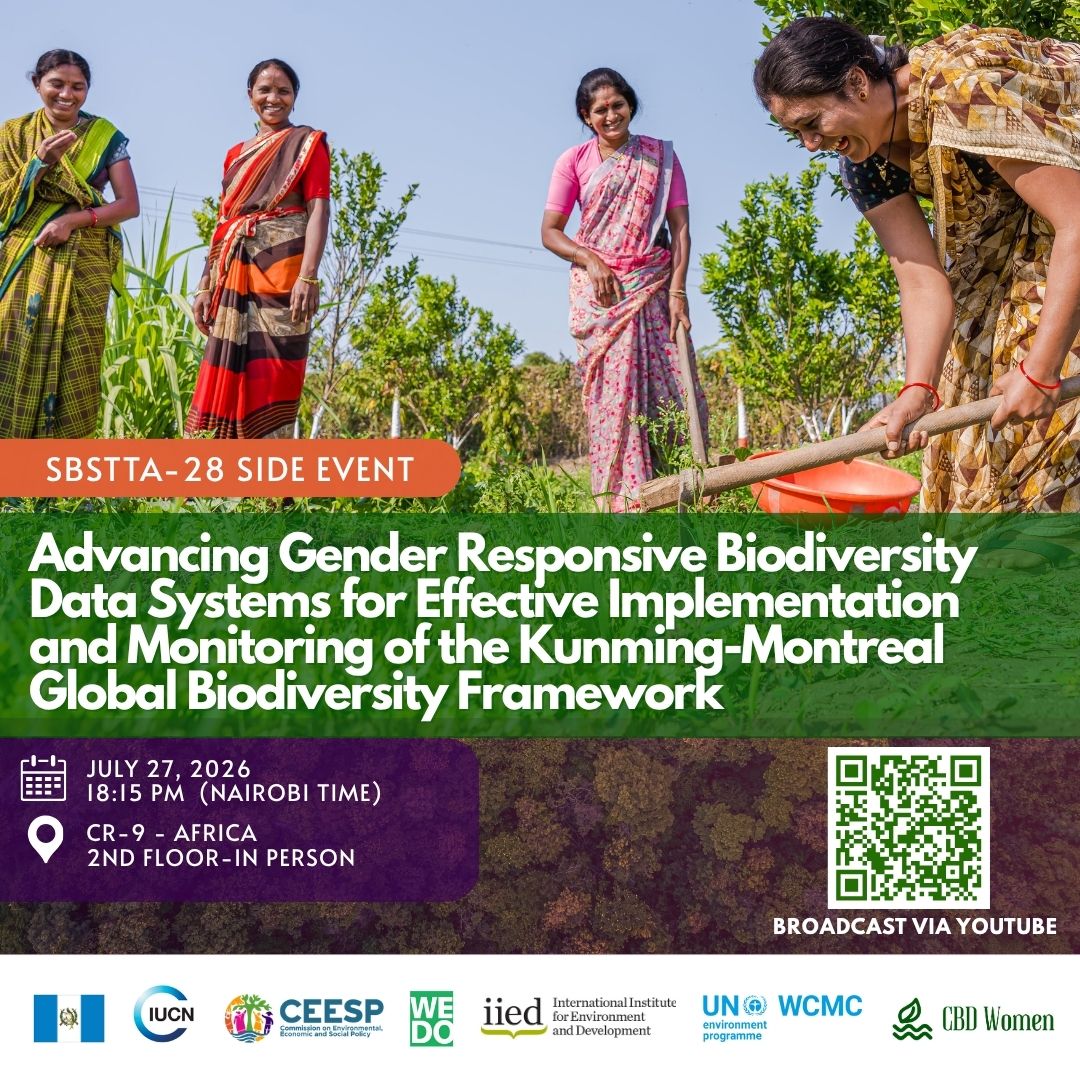
Title Advancing Gender Responsive Biodiversity Data Systems for Effective Implementation and Monitoring of the Kunming-Montreal Global Biodiversity Framework
Hosts
CBD Women Caucus | UNEP-WCMC | IIED | IUCN CEESP | WEDO |
Topics
Kunming-Montreal Global Biodiversity Framework
Gender and Biodiversity
Subsidiary Body on Scientific, Technical and Technological Advice (SBSTTA)
National Biodiversity Strategies and Action Plans (NBSAPs)
National Reports
Indicators
Implementation of the Convention on Biological Diversity


Title: Advancing Gender Responsive Biodiversity Data Systems for Effective Implementation and Monitoring of the Kunming-Montreal Global Biodiversity Framework


Co-Conveners: CBD Women’s Caucus, Guatemala, UNEP-WCMC, IUCN-CEESP, IIED, WEDO/GEDA.


Date: Monday 27 July 2026

Time: 18:15 to 19:20 (UTC+3)

Room: CR-9 - Africa / 2nd floor


Description

The implementation of the Kunming-Montreal Global Biodiversity Framework (KMGBF) requires robust, inclusive, and actionable biodiversity data systems capable of informing policy, monitoring progress, and supporting accountability. However, major gaps remain in the availability, accessibility, and use of gender-responsive biodiversity data across national and global monitoring processes.

Women, Indigenous Peoples and local communities, youth, and grassroots organizations are key knowledge holders and biodiversity stewards, yet their contributions often remain invisible within biodiversity monitoring frameworks and national reporting systems. Strengthening gender-responsive biodiversity data systems is therefore essential for achieving equitable and effective implementation of the KMGBF. 

In addition, important progress has already been made under the Convention on Biological Diversity to strengthen gender-responsive implementation and monitoring approaches. The development of the Component Indicator on National Implementation of the Gender Plan of Action provides a basis for assessing progress on gender integration within national biodiversity processes. The methodology for this indicator was acknowledged by Parties in Decision 16/31, reflecting growing recognition of the need for more systematic approaches to monitoring gender-responsive implementation under the Convention.

The mid-term review of the Gender Plan of Action which was discussed in the sixth meeting of the Subsidiary Body on Implementation(SBI-06) received limited responses and revealed that gender-disaggregated data, particularly data linking gender and biodiversity, remains insufficient, fragmented, or unavailable in many national contexts, limiting evidence-based implementation and effective monitoring of progress. The review also identified limited institutional capacity, inadequate resources, and weak coordination among actors involved in data generation, management, and governance as key barriers. Several submissions further emphasized the need to develop stronger gender-responsive indicators for monitoring and evaluation under the Convention.

As Parties prepare for the global review of collective progress and further refinement of the monitoring framework at SBSTTA-28, there is a timely opportunity to highlight practical approaches, case studies, methodologies, and partnerships that can support gender responsive biodiversity monitoring and evidence-based policymaking. Current SBSTTA-28 preparations specifically emphasize the monitoring framework, national reporting, technical capacity needs, and scientific support for implementation of the KMGBF.

This side event will provide a platform for governments, women’s organizations, researchers, Indigenous Peoples and local communities representatives, and technical experts to exchange experiences and identify pathways to strengthen gender-responsive biodiversity data governance and implementation.


Objectives:


  • Highlight the importance of gender-responsive biodiversity data for effective implementation and monitoring of the KMGBF.

  • Showcase practical tools, methodologies, and case studies that strengthen inclusive biodiversity monitoring systems.

  • Identify persistent gaps and challenges in collecting, analyzing, and using gender-responsive biodiversity data.

  • Generate recommendations for strengthening technical capacity, monitoring systems, and inclusive reporting processes under the Convention.


Proposed Run of Show (65 min)

Time

Segment

Description

Resource person

18:15–18:20

Welcome (5 min)

  • Welcome

  • House keeping

  • Session’s objectives and format

Moderator – CBD Women's Caucus

18:20–18:25

Setting the Scene (5 min)

  • Current state of monitoring (what is already available for monitoring gender)

  • Existing data gaps

  • Why this matters for implementation and decision-making

  • Data for decision making

UNEP-WCMC

18:25–18:30

Government Experience (5 min)

Building gender-responsive biodiversity information systems at the national level.


How to close silos between ministries/offices: statistical offices, environment or women?

Guatemala - Video

18:30–18:35

Territorial Perspectives (5 min)

  • What knowledge is currently invisible?

  • What kinds of data should governments value?

  • What barriers exist?

Representative from Community based organisation - Name TBC

18:35–18:42

Methods and Evidence (7 min)

  • Gender & Biodiversity Data Initiative 

  • How do we actually generate gender-responsive biodiversity data?

  • Share practical methodologies, tools and examples.


IIED (2 min)

CBD WC (5 min)

18:45–19:15

Moderated Dialogue (30 min)

Possible guiding questions:

How do we generate better gender-responsive biodiversity data?

(Methods, community monitoring, indicators)

How do we integrate these data into national systems and reporting?

(8th National Reports, interoperability, cross ministries and statistical offices collaboration)

How do we ensure these data actually influence policy and global assessments?

(GPA review, Global review, IPBES 2nd Global assessment)

All speakers together.


Guatemala (video)

Community Rep

CBD Women’s Caucus

UNEP-WCMC

19:15–19:20

Closing (5 min)

Close with three recommendations emerging from the discussion.

CBD Women's Caucus


During the session there will be a running mentimeter for participants to provide their perspectives: What is one concrete action you can take in the next six months to strengthen gender-responsive biodiversity monitoring and reporting? 


Contact: shruti@cbdwomencaucus.org 


Error as occured...
File Title & Description Tags

Policy Brief: Advancing gender justice in biodiversity data and policy


This policy brief presents findings from a collaborative effort led by the CBD Women’s Caucus and the International Institute for Environment and Development (IIED) to better understand how women-led and community-based organisations generate and use biodiversity data with a gender perspective. It highlights the critical role that women and girls in all their diversity, including from Indigenous Peoples, and from local and Afro-descendant communities, play in producing knowledge that informs conservation, sustainable use and rights-based approaches. Drawing on diverse experiences and practices, the brief explores how gender-responsive biodiversity data is currently collected, managed and applied across contexts. It identifies key strengths, including the centrality of lived experience, traditional knowledge and community-rooted evidence, while also examining persistent barriers such as limited funding, weak data systems, restricted access to decision-making spaces and insufficient recognition of this work. This brief forms part of the broader initiative “Advancing gender justice in biodiversity data and policy”, led by the CBD Women’s Caucus in collaboration with IIED. The initiative aims to strengthen the capacities of women’s organisations to generate and use gender-responsive data, support the co-creation of evidence to influence biodiversity policy, and foster collective learning processes across regions.


Findings Report: Advancing gender justice in biodiversity data and policy


This findings report, developed by the CBD Women’s Caucus in partnership with IIED, presents an exploratory, network-based mapping of capacities, practices and needs related to gender-responsive biodiversity data among women-led and community-based organisations. It examines engagement across the biodiversity data value chain — from data collection and management to analysis and use — based on 70 survey responses from 33 countries. The findings show that women-led and community-based organisations are already generating vital, community-rooted biodiversity data. Organisations are particularly active in data communication and use, while also contributing significantly to data collection and analysis. However, important gaps remain, particularly in data management, where lower levels of engagement may affect the long-term accessibility and usability of evidence. The report also highlights the central role of qualitative and narrative-based approaches — such as interviews, storytelling and focus groups — in capturing lived experiences and advancing gender-responsive knowledge systems. Despite strong engagement and ethical intent, organisations face persistent structural barriers, including limited funding, access to technology and technical capacities. Critically, the report finds that the main constraint to policy impact is not the lack of data, but its limited recognition and uptake in decision-making processes. At the same time, the findings point to significant opportunities for peer-to-peer learning and for strengthening a whole-of-society approach to biodiversity monitoring and reporting, building on the existing contributions of women-led organisations to advance more gender-just biodiversity governance. This report forms part of the broader initiative “Advancing gender justice in biodiversity data and policy”, led by the CBD Women’s Caucus in collaboration with IIED. The initiative aims to strengthen the capacities of women’s organisations to generate and use gender-responsive data, support the co-creation of evidence to influence biodiversity policy, and foster collective learning processes across regions.


Error as occured...
File Title & Description Tags


Error as occured...
File Title & Description Tags


Documents