Error as occured...

Side Event #7425

Status: PUBLISHED

Date Friday
2026.10.30 @ 13:15
Add to Calendar
Room Spitak - Side-event Room 2 - Level 2

Capacity: 95 people
Conference COP-17 / CP-MOP-12 / NP-MOP-06
Meetings(s)
COP-17
Seventeenth meeting of the Conference of the Parties to the Convention on Biological Diversity
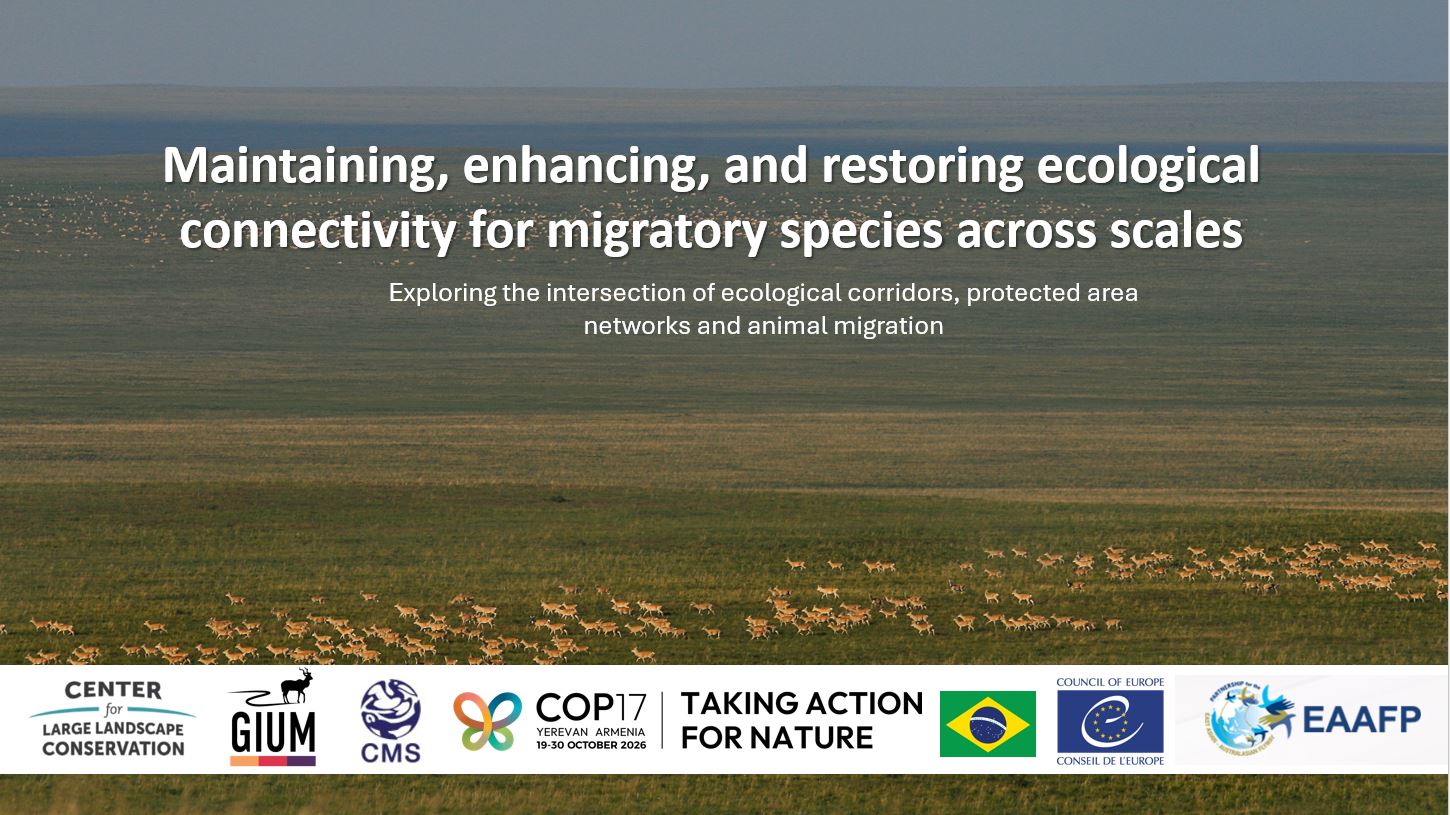
Title Maintaining, enhancing, and restoring ecological connectivity for migratory species across scales
Hosts
CMS | EAAFP | CLLC | Bern Convention |
Topics
In-Situ Conservation
Protected Areas and OECMs
Scientific, Technical and Technological Matters
Implementation of the Convention on Biological Diversity
Kunming-Montreal Global Biodiversity Framework
Planning


Conserving ecological connectivity is increasingly viewed as a unifying axis to more effectively achieve international environmental commitments. The push to emphasize and formalize ecological connectivity within the Convention on Biological Diversity’s (CBD) forthcoming revised Programme of Work on Protected Areas is an important step for global conservation and for achieving the targets of the Kunming-Montreal Global Biodiversity Framework (KMGBF). In light of this growing momentum, there is an urgent need to further integrate a critical and under-explored aspect of global biodiversity into conservation planning and implementation: the intersection of ecological corridors and animal migration. The annual pulse of migratory species on seasonal journeys promotes abundances and biodiversity, yet in March 2026, the UN Convention on Migratory Species (CMS) Interim report found that 44% of CMS-listed species are in decline, and that only half of the area of Key Biodiversity Areas identified as important for migratory species affords protections or conservation status. While KMGBF Target 3 focuses on 30% protection of ecosystems, for migratory species the extent to which sites are protected and well-connected as functional networks – rather than mere spatial extent – is critical for enabling them to complete their seasonal journeys. Not surprisingly, safeguarding habitat for migratory and wide-ranging species remains a challenge for biodiversity and spatial planning, infrastructure development, and protected and conserved area designation. This event will bring together diverse perspectives from around the world to increase understanding and inspire action for the habitat connectivity of migratory species aligned with Agenda Item 17: "Scientific and technical needs to support the implementation of the Kunming-Montreal Global Biodiversity Framework," specifically the "Strategic review of and updates to the programme of work on protected areas," as well as Item 18 "Other scientific and technical issues related to the implementation of the Kunming-Montreal Global Biodiversity Framework."

Participants will gain insights from around the world that will:

  • Highlight the identification, conservation and management of site networks for long-distance migratory waterbirds and migratory freshwater fish.
  • Discuss how countries can better utilize terrestrial migration movement and migratory species data to inform biodiversity monitoring and planning, highlighting several case studies where ungulate tracking data served to ensure that infrastructure remained permeable for migrating wildlife and to highlight critical gaps and opportunities for new OECMs, PAs, and other conservation solutions based in empirical migration corridor maps.
  • Provide a more operational framework for interpreting the “well-connected” element of KMGBF Target 3 based on statistical thresholds for indicators currently in the monitoring framework.
  • Present lessons learned arising from the implementation of the Bern Convention, which provides a significant pan-European contribution to the implementation of the KMGBF and Target 3, with a particular focus on migratory species. The Bern Convention Parties have accumulated valuable experience through the Emerald Network, an ecological network of protected areas operational in 43 European countries, safeguarding 210 habitats and over 1,250 species and supporting the conservation of migratory species and their habitats.

Lead organizations:

  • UN Convention on Migratory Species, Global Initiative on Ungulate Migration
  • East Asian - Australasian Flyway Partnership (EAAFP)
  • Center for Large Landscape Conservation (CLLC)
  • IUCN World Commission on Protected Areas Connectivity Conservation Specialist Group (CCSG)
  • Council of Europe Bern Convention

Error as occured...
File Title & Description Tags

Mapping out a future for ungulate migration: Limited mapping of migrations hampers conservation


Migration of ungulates (hooved mammals) is a fundamental ecological process that promotes abundant herds, whose effects cascade up and down terrestrial food webs. Migratory ungulates provide the prey base that maintains large carnivore and scavenger populations and underpins terrestrial biodiversity (fig. S1). When ungulates move in large aggregations, their hooves, feces, and urine create conditions that facilitate distinct biotic communities. The migrations of ungulates have sustained humans for thousands of years, forming tight cultural links among Indigenous people and local communities. Yet ungulate migrations are disappearing at an alarming rate (1). Efforts by wildlife managers and conservationists are thwarted by a singular challenge: Most ungulate migrations have never been mapped in sufficient detail to guide effective conservation. Without a strategic and collaborative effort, many of the world's great migrations will continue to be truncated, severed, or lost in the coming decades. Fortunately, a combination of animal tracking datasets, historical records, and local and Indigenous knowledge can form the basis for a global atlas of migrations, designed to support conservation action and policy at local, national, and international levels.

science.abf0998.pdf


From science to impact: Conserving ecological connectivity in large conservation landscapes


Implementing ecological connectivity conservation in large landscapes requires cutting-edge science combined with consideration of ecological, socioeconomic, and cultural factors that collectively shape the outcomes of conservation efforts. We outline a theory of change (ToC) for connectivity conservation to improve the ecological condition of landscapes and biodiversity and the ecosystem services upon which humans depend. We review connectivity conservation efforts on four continents in large landscapes that span gradients of latitude, fragmentation, biodiversity value, socioeconomic characteristics, and the richness of data used to assess connectivity and target action. We share the substantial but variable progress made in each landscape and outline specific challenges to achieving conservation goals. Opportunities and challenges in public and private sectors can further leverage the potential of large-scale connectivity conservation to reduce isolation and improve gene flow in functional landscapes worldwide.

naidoo_et_al_2025_from_science_to_impact_conserving_ecological_connectivity_in_large_conservation_landscapes.pdf


State of the World's Migratory Species: Interim Report 2026


The first State of the World’s Migratory Species was launched at the 14th meeting of the Conference of the Parties of the Convention on the Conservation of Migratory Species of Wild Animals (CMS COP14), in February 2024. The report revealed that the extinction risk of CMS-listed species is rising, and that the same trend is evident for migratory species as a whole (including those not listed in the CMS Appendices). This concerning trajectory is the result of intensifying pressure from human activities, with many migratory species exposed to a combination of interacting threats occurring in multiple different locations on their migratory routes. This interim report, produced for CMS COP15 in response to Decision 14.24 d), provides an update on major developments in the conservation status of CMS-listed species since COP14. It includes an analysis of updates to the IUCN Red List of Threatened SpeciesTM and summarizes insights on population trends and distribution changes from recently published scientific literature. It also provides an update on the extent to which important habitats for CMS- listed species have been identified and protected. Finally, it shines a spotlight on several initiatives that are mapping the routes and pathways used by migratory species.

swms_interim-report_2026_e_0.pdf


Error as occured...
File Title & Description Tags


Error as occured...
File Title & Description Tags


Documents