2026 Winners
 Lisa Paguntalan – Marte (Philippines) Executive Director, Philippines Biodiversity Conservation Foundation Inc. (PhilBio)
. For more than 25 years, Lisa Paguntalan-Marte has dedicated herself to biodiversity conservation in the Philippines. She has made outstanding contributions to the research and conservation of threatened species, including the rediscovery of the Philippine Bare-backed Fruit Bat, once thought to be extinct, and the conservation of endangered species such as the Visayan Hornbill. She has also led the local implementation of the Philippine Biodiversity Strategy and Action Plan (PBSAP) and established mechanisms to integrate biodiversity conservation into local government planning and budgeting, thereby advancing its mainstreaming. In addition, she has championed initiatives that respect the rights of Indigenous Peoples and promote the participation of women, establishing a sustainable conservation model that bridges policy and local communities.
 Alexandra Zimmermann (Germany) Chair, IUCN SSC Human-Wildlife Conflict & Coexistence Specialist Group
. As conflicts between people and wildlife continue to intensify around the world, Prof. Alexandra Zimmermann has been a global leader in advancing human–wildlife coexistence as a key priority for biodiversity conservation for more than 25 years, driving research, practical implementation, and policy development. She founded the IUCN SSC Human–Wildlife Conflict & Coexistence Specialist Group, leading the development of international guidance and the establishment of a global network of practitioners. She has also pioneered the application of knowledge and approaches from peacebuilding and conflict resolution to biodiversity conservation. Furthermore, she has fostered international collaboration among researchers, practitioners, and policymakers, helping to establish human–wildlife coexistence as a key priority in biodiversity policy.
2024 Winners
 Vera Voronova (Kazakhstan) Executive Director, Association for the Conservation of Biodiversity of Kazakhstan
. Vera Voronova is the exceptional leader of ACBK, Kazakhstan’s national civil society organization dedicated to nature conservation and restoration. She collaborates with multiple governments and conservation organizations to restore species, establish protected areas, and improve conservation legislation not only in Kazakhstan but throughout Central Asia. Particular focus is placed on the recovery of endangered mammal populations in the steppe regions, restoration of migration corridors, and protection of the Central Asian Flyway. Her initiatives have directly improved the livelihoods of rural communities, educated the next generation on environmental and conservation issues, and contributed to the conservation of migratory animals that cross national borders. Her approach serves as an exemplary model of engagement at all levels, employing whole-of-government and whole-of-society strategies. The project is expected to have further international impacts.
 Ysabel Agustina Calderón Carlos (Peru) Founder and CEO of Sumak Kawsay, an environmental enterprise
. Ysabel Agustina Calderón Carlos, founder and CEO of Sumak Kawsay, effectively leads conservation efforts aimed at halting and reversing pollinator decline while fostering socio-economic development in local communities, especially Indigenous women and youth. Her “Bee Honey Route” project promotes agrotourism, using honey production from native stingless bees and tourism revenue to fund ecosystem restoration, native plant reforestation, research, and conservation. The work yields tangible benefits for biodiversity and ecosystems, supports sustainable livelihoods, and advances gender equality. The environmental enterprise has created an innovative business model that benefits both biodiversity and civil society, supporting economic development and Indigenous rights. Recognized internationally, her initiatives serve as a model for holistic societal approaches.
Access here the
press release.
2020 Winners
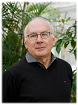 Paul Hebert Professor, Department of Integrative Biology, University of Guelph(Canada)
. Dr. Paul Hebert holds a Canada Research Chair in Molecular Biodiversity at the University of Guelph where he is the Director of its Centre for Biodiversity Genomics. For the past 20 years, his research has focused on the development of an innovative technique termed DNA barcoding which can almost instantly assign any organism to its proper species. The resulting biodiversity data represent a “global public library” which now contains information on more than 10 million specimens. By establishing the International Barcode of Life Consortium, he created a research alliance which is revolutionizing our understanding of planetary biodiversity. Dr. Hebert’s work is reinforcing our appreciation for the value of nature, aiding its protection, facilitating biodiversity monitoring, and providing everyone with easy access to biodiversity knowledge.
 Melina Sakiyama, Co-founder, Global Youth Biological Network (Brazil)
. In the context of her participation in the 10th Conference of the Parties to the Convention on Biological Diversity in 2010, Ms. Melina Sakiyama met other young people who shared her vision. Together with Mr. Christian Schwarzer, she co-founded the Global Youth Biodiversity Network (GYBN), with the aim to create a global coalition of empowered youth and youth organizations to build a shared future in harmony with nature. As part of the team, Ms. Sakiyama led efforts to design capacity-building and youth empowerment programmes that supported hundreds of young leaders and youth-led biodiversity conservation initiatives, thus contributing to the implementation of the Aichi Biodiversity Targets and the objectives of the Convention. The Network comprises 551 youth groups, organizations and movements from 145 countries who participate and collaborate with each other on project implementation, policy-making and awareness-raising on biodiversity, and continues to expand across borders and issue areas.
 Wirsiy Emmanuel Binyuy, Founder, Cameroon Gender and Environment Watch (CAMGEW) (Cameroon)
. In 2007, Mr. Wirsiy founded the Cameroon Gender and Environment Watch, which focus on solutions to environmental and gender issues. The initiative works with the slogan "think globally, act locally”; it involves local communities in forest conservation and regeneration efforts to collect forest seeds and seedlings, develop tree nurseries, plant forest trees and do forest patrols. Mr. Wirsiy’s apiculture initiatives provided micro-financing opportunities for women, brought sustainable sources of income to communities and reduced bushfires drastically in the regions. He has been leading environmental educational campaign to raise the awareness of hundreds of thousands of forest people and has contributed largely in the regeneration of biodiversity hotspots. Mr. Wirsiy has empowered bee farmers and organized them to honey cooperatives to increase honey quality and quantity for a better market.
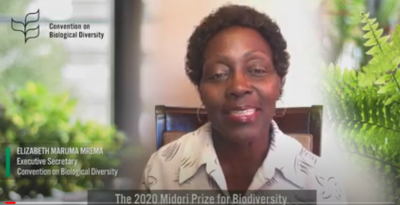
Watch the
video message from Ms.Elizabeth Maruma Mrema, CBD Executive Secretary, congratulating the winners of the 2020 MIDORI Prize.
2018 Winners
- Dr. Kathy MacKinnon, Chair, IUCN World Commission on Protected Areas (WCPA) (UK). After engaging in field research as a biologist in Indonesia for ten years, Dr. Kathy MacKinnon was appointed as the Lead Biodiversity Specialist of the World Bank. She contributed to numerous projects to strengthen biodiversity conservation and natural resource management in many developing countries in Africa, Asia and Central and South America. She has been cooperating with multiple stakeholders and focusing on mainstreaming of biodiversity in the development programs and securing local sustainable livelihood. Currently she is serving as the Chair of the IUCN World Commission on Protected Areas (WCPA) and she has been contributing greatly to the achievement of the Aichi Biodiversity Targets.
- Mr. Assad Serhal, Director General, Society for the Protection of Nature in Lebanon (SPNL) (Lebanon). During the civil war in Lebanon, Mr. Assad Serhal established the Society for the Protection of Nature in Lebanon (SPNL) to protect the natural heritage of Lebanon. Finding that Western models for nature conservation and management did not resonate with local communities in the Middle East, SPNL revitalized “Hima” (“protected area” in Arabic), the community-based traditional system for area-based conservation. Mr. Serhal has contributed to the establishment of 21 Himas covering terrestrial, wetland and marine ecosystems and successfully conserving wildlife habitat, pasture land and water resources. They have also empowered the communities and brought the communities a sustainable livelihood. This approach has been adopted elsewhere in the region.
- Dr. Abdul Hamid Zakri, Joint-Chair, Malaysian Industry-Government Group for High Technology (MIGHT), Former Science Advisor to the Prime Minister of Malaysia (Malaysia).Dr. Abdul Hamid Zakri has been contributing to the observation, analysis and evaluation of global biodiversity and ecosystem services in a career spanning more than four decades, promoting nature conservation and restoration, and contributing to the sustainability of the environment. As a co-chair of the UN Millennium Ecosystem Assessment (MA) and founding chair of the Intergovernmental Science-Policy Platform on Biodiversity and Ecosystem Service (IPBES), he played an important role in raising awareness of biodiversity among global leaders. He also contributed to the promotion of SATOYAMA initiative.
2016 Winners
- Dr. Alfonso Aguirre-Muñoz, Executive Director of Grupo de Ecología y Conservación de Islas, A.C. (Mexico). Dr. Aguirre-Muñoz has worked tirelessly in the Mexican islands—unique ecosystems and home to abundant endemic species—to remove invasive species and actively restore seabird populations and vegetation communities. Thanks to his interdisciplinary collaboration involving fishermen cooperatives, private donors, the Mexican Navy and federal government agencies, protected areas in excess of 40,000 ha stretching over vast island regions have been created. He has also made a significant contribution to Revillagigedo Archipelago’s (“Mexican Galapagos”) recent recognition by UNESCO as a World Heritage Site.
- Dr. Yury Darman, Director of WWF-Russia Amur Branch (Russia). Concerned about the impact on freshwater ecosystems of proposals for dams within the Russian Far Eastern Region, Dr. Darman organized five campaigns against their construction. He has extolled tremendous efforts to increase populations under the umbrella of iconic rare species, including the Amur tiger. Vast nature reserves extending beyond Russia’s border to China and Mongolia were established as areas of international cooperation based on an approach that integrates scientific and traditional knowledge. He addresses contemporary challenges through a focus on the nexus between biodiversity and climate change.
- Dr. Vandana Shiva, Founder and Director of Navdanya (India).Centered on the principle of ‘Earth Democracy,’ Dr. Shiva formed a grassroots movement “Navdanya” to save seeds, protect farmers’ rights and biodiversity, and promote traditional organic farming methods that raise levels of nutrition and income, thus reducing both hunger and poverty. In the context of the global discourse on biodiversity and biosafety, she has demonstrated unshakable resolve in speaking out for marginalized populations and women, and also achieved notable success in establishing sustainable societies based on models contributing to access and benefit-sharing of genetic resources.
2014 Winners
- Dr. Kamal Bawa, President of Ashoka Trust for Research in Ecology and the Environment (ATREE), India, and Distinguished Professor of university of Massachusetts, Boston. Dr. Bawa is globally recognized for the results of his research on tropical forests. Through developing new methods and genetic markers he has shown that forest fragmentation, widespread in the tropics, depletes biodiversity. He has led research on conservation biology for many years, including on the extraction of non-timber products and on mainstreaming biodiversity into agricultural landscapes. He established the Ashoka Trust for Research in Ecology and the Environment (ATREE) as a research institution for biodiversity conservation and sustainable development. He has displayed operational leadership and integrally promoted research, education and implementation at the ATREE.
- Dr. Alfred Oteng-Yeboah, Chair of Ghana National Biodiversity Committee, Ghana. Dr. Oteng-Yeboah is a leader in biodiversity-related foras, including as a representative of Africa. He has held several important positions within international biodiversity-related institutions including as Chair of the Subsidiary Body on Scientific, Technical and Technological Advice (SBSTTA). He has led international negotiations on biodiversity from a global perspective and his work had, and continues to have, an impact worldwide. Importantly, he contributed to the establishment and management of the Intergovernmental Science-Policy Platform on Biodiversity and Ecosystem Services (IPBES) through advocating the importance of dialogues between science and policy.
- Dr. Bibiana Vilá, Director of Vicuñas, Camelids and Environment (VICAM), and Principal Researcher of National Research Council (CONICET), Argentina. Specialized in the conservation of wild vicuñas in the Andean altiplano, Dr. Vilá has led the implementation of conservation measures integrating both traditional knowledge of indigenous communities and modern science including ecology, ethology and animal welfare. Her work in promoting support to local communities and the implementation of environmental education has had significant impact in the region. Her efforts focus on promoting the sustainable use of economically high-value vicuña fiber, thus contributing to the conservation of wild animals and the stable development of regional communities. The work of Dr. Vilá demonstrates that local-based projects can have repercussions at the regional and global levels.
2014 News
2012 Winners
- Dr. Juan Carlos Castilla, Professor of Marine Ecology at Pontificia Universidad Catolica de Chile. As "the pioneer of South American marine ecology,” Dr. Castilla has been involved in national strategies promoting the conservation and sustainable use of biodiversity. He worked with governments, coastal and more marginalized artisanal fisher communities, and proved that the small scale Marine Protected Area is effective for sustainably developing the community as well as growing a green economy.
- Dr. Rodrigo Gamez-Lobo, President of Instituto Nacional de Biodiversidad (INBio). Dr. Gámez founded and initiated the INBio in Costa Rica, a country of mega-diversity. He provided a successful model for the conservation and sustainable use of biodiversity to the world in various fields including the inventorying of biodiversity, environmental education, bioprospecting, policy and legislation, land use management/technical assistance, capacity building and eco tourism.
- Dr. Vo Quy, Honorary President at the Center for Natural Resources Management and Environmental Studies (CRES), Vietnam National University, Hanoi. Dr. Quy, who took the initiative to involve rural communities as the main proponents of the country’s nature conservation and reforestation program, is rightly called the father of Vietnam’s environmental conservation movement. He showed a model of the conservation and rehabilitation of nature, offering hope that lands devastated by urbanization or warfare can be regenerated.
2012 News
The establishment in 2010 of “The MIDORI Prize for Biodiversity” corresponded to the 20th anniversary of the AEON Environmental Foundation and commemorated the International Year on Biodiversity 2010 as well as the hosting by Nagoya, Aichi Prefecture and Japan of the tenth meeting of the Conference of the Parties to the Convention on Biological Diversity. The 2010 Award Ceremony took place at the occasion of the the high-level segment of the tenth meeting of the CBD Conference of the Parties. More information on the 2010 edition is available
here.
2010 Winners
In 2010, the first MIDORI Prizes were awarded to:
- Mr. Jean Lemire, biologist, explorer, filmmaker, Canada. Mr. Jean Lemire has been contributing to raising awareness and supporting child and youth education in recognizing the importance of biodiversity and becoming involved in action to preserve life on Earth by taking advantage of his unique background as both a biologist and filmmaker.
- Dr. Gretchen C. Daily, Professor, Stanford University, United States of America. Dr. Daily is a scholarly researcher in the Department of Biological Sciences at Stanford University. She has discovered the economic costs of environmental destructions, caused by human societies and their economic activities, and has contributed to the preservation of the ecosystem utilizing the concept of "ecosystem services."
- Dr. Emil Salim, Chairman of the Advisory Council to the President of Indonesia and former Minister of State for Population and the Environment, Indonesia. Dr. Salim has been taking a leadership role not only in Indonesian environmental policy formation and its implementation and the promotion of activities for environmental NGOs but also in international conferences on the simultaneous pursuit of environmental conservation and economic development.
- Mrs. Angela Merkel, Chancellor of Germany. Mrs. Angela Merkel has demonstrated strong leadership of global environmental issues including climate change and biodiversity conservation policy at national, EU and international levels as the Chancellor of Germany. Mrs. Merkel received the Special MIDORI Prize for the International Year of Biodiversity 2010.
2010 News
