2017-2018 inter-sessional period
The thirteenth meeting of the Conference of the Parties to the Convention (COP 13) and the second meeting of the Conference of the Parties serving as the meeting of the Parties to the Nagoya Protocol (COP-MOP 2) respectively adopted decisions on digital sequence information on genetic resources in which they recognized the need for a coordinated and non-duplicative approach on this matter under the Convention and the Nagoya Protocol (decisions XIII/16 and NP-2/14, respectively).
The process agreed to in decisions XIII/16 and NP-2/14 entails the submission of views and information, the commissioning of a study, work by an ad hoc technical expert group (AHTEG), consideration of the outcomes by the Subsidiary Body on Scientific, Technical and Technological Advice, and recommendations by the Subsidiary Body to the fourteenth meeting of the Conference of the Parties to the Convention and the third meeting of the Parties to the Nagoya Protocol.
Please click for more information:
- AHTEG on Digital Sequence Information on Genetic Resources
- Peer review of the fact-finding and scoping study
- Submissions of views and information
AHTEG on Digital Sequence Information on Genetic Resources
An Ad Hoc Technical Expert Group (AHTEG) on Digital Sequence Information on Genetic Resources was established by decision XIII/16 of the Conference of the Parties of the Convention on Biological Diversity. In accordance with decision NP-2/14, the AHTEG will also serve the Nagoya Protocol.
A meeting of the AHTEG on Digital Sequence Information on Genetic Resources was convened thanks to the financial support of the Government of Canada and the European Union from 13 to 16 February 2018 in Montreal, Canada. Among other tasks, the AHTEG considered the compilation and synthesis of views and information submitted by Parties, other Governments, relevant organizations and stakeholders, as well as a fact-finding and scoping study commissioned by the Executive Secretary.
The report will be considered by SBSTTA-22.
Meeting of the AHTEG on Digital Sequence Information on Genetic Resources (13-16 February 2018)
- Terms of reference of the AHTEG (annex to decision XIII/16)
- Composition of the AHTEG
- Documents for the meeting
- Peer review comments on the fact-finding and scoping study
- Submission of views and information from Parties, other Governments, relevant organizations and stakeholders
Peer review of the fact-finding and scoping study
The Executive Secretary was requested to commission a fact-finding and scoping study to clarify terminology and concepts and to assess the extent and the terms and conditions of the use of digital sequence information on genetic resources in the context of the Convention and the Nagoya Protocol.
The study was carried out thanks to financial support from the European Union and the Governments of Canada and Switzerland. It was made available for peer-review (notification 2017-115) between 9 November and 1 December 2017. The comments received in response to this notification are presented below in the form and language in which they were received.
Parties
- Argentina
- Australia
- Belgium
- Brazil
- China
- European Union
- Finland
- India
- Mexico
- South Africa
- Switzerland, Federal Office for Agriculture
- Switzerland, Federal Office for Agriculture 2
- Switzerland, Federal Office for the Environment
- Switzerland, Federal Institute of Intellectual Property
CBD non-Parties
Organizations and stakeholders
- BioBricks Foundation
- Chartered Institute of Patent Attorneys
- DivSeek
- Jerome Reichman, Duke Law School
- European Seeds Association
- Global Biodiversity Information Facility (GBIF)
- Global Genome Biodiversity Network
- Global Initiative on Sharing All Influenza Data (GISAID Initiative)
- Indian Council of Agricultural Research - National Bureau of Agriculturally Important Microorganisms
- Jeshima K. Yasin, Indian Council of Agricultural Research - National Bureau of Plant Genetic Resources
- Paul Oldham, Institute for Advanced Study of Sustainability - United Nations University
- International Union for the Protection of New Varieties of Plants (UPOV)
- Robert Friedman, J. Craig Venter Institute
- Leibniz Association
- Mexican Association of Botanical Gardens
- Christopher Lyal, Natural History Museum
- Manuel Ruiz, Peruvian Society for Environmental Law
- Society for Industrial Microbiology and Biotechnology
- Third World Network
- Twist Bioscience
- United Nations Division of Ocean Affairs and the Law of the Sea
- Scott and Berry, University of Edinburgh
- Joseph Henry Vogel, University of Puerto Rico
- Steven Trim, Venomtech
- Wellcome Trust
- World Health Organization (WHO)
Submissions from Parties, other Governments, relevant organizations and stakeholders
In decision XIII/16, the Conference of the Parties to the Convention on Biological Diversity invited Parties, other Governments, indigenous peoples and local communities, and relevant organizations and stakeholders to submit views and relevant information to the Executive Secretary on any potential implications of the use of digital sequence information on genetic resources for the three objectives of the Convention. The Conference of the Parties serving as the meeting of the Parties to the Nagoya Protocol invited these submissions to include information relevant to the Nagoya Protocol (decision NP-2/14).
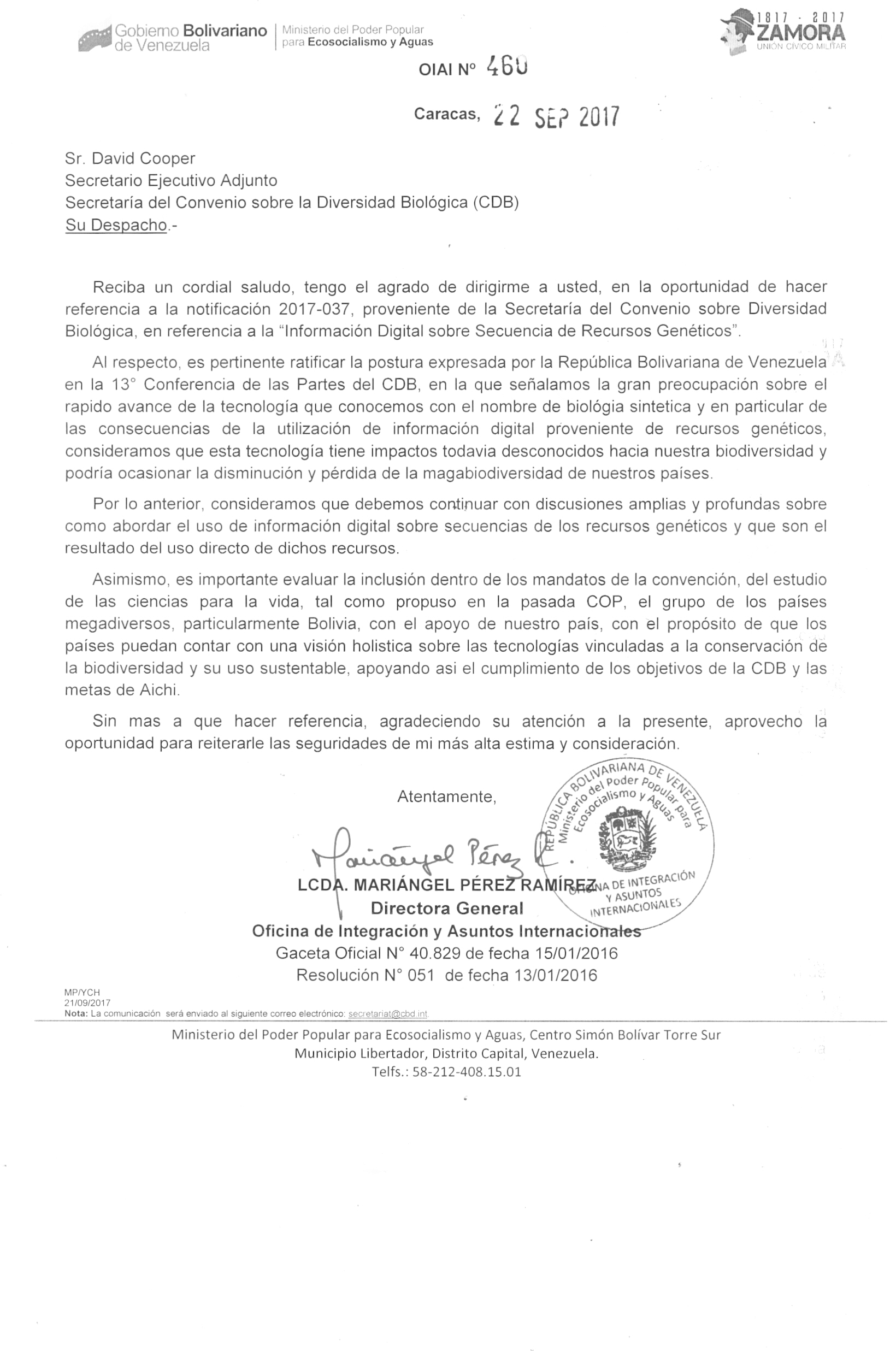
The Secretariat invited the submission of views and information through notification 2017-37. The submissions received by the Secretariat in response are available below.
CBD Parties
- Argentina
- Australia
- Belarus
- Brazil
- Canada
- Ecuador
- Ethiopia
- Ethiopia on behalf of the African Group
- European Union and Member States
- India
- Japan
- Mexico
- Switzerland
- Venezuela
CBD Non-Parties
Organizations and Stakeholders
- African Center for Biodiversity
- Alliance of Science Organizations in Germany (received 10 February 2018) English German
- Biodiversity Institute of Ontario, University of Guelph
- BioIndustry Association (BIA)
- Biotechnology and Biological Sciences Research Council
- CABI (Centre for Agriculture and Biosciences International)
- Consortium of European Taxonomic Facilities, ABS Core Group
- Commission on Genetic Resources for Food and Agriculture (Part 1)
- Commission on Genetic Resources for Food and Agriculture (Part 2)
- Commission on Genetic Resources for Food and Agriculture (Part 3)
- Commission on Genetic Resources for Food and Agriculture (Part 4)
- Commission on Genetic Resources for Food and Agriculture (Part 5)
- Consultative Group on International Agricultural Research (CGIAR) English French Spanish
- Enzyme Technical Association
- European Seed Association
- German Life Sciences Association (VBIO)
- German Research Foundation (DFG)
- Global Genome Biodiversity Network
- Global Initiative on Sharing All Influenza Data (GISAID Initiative)
- Heinrich Böll Foundation
- Institute for Agriculture and Trade Policy
- Intellectual Property Owners Association (IPO)
- International Chamber of Commerce
- International Federation of Pharmaceutical Manufacturers & Associations (IFPMA)
- International Fragrance Association (IFRA) and International Organization of the Flavor Industry (IOFI)
- International Treaty on Plant Genetic Resources for Food and Agriculture (ITPGRFA)
- Japan Bioindustry Association
- Japan Pharmaceutical Manufacturers Association
- LGC Group
- Natural History Museum, Royal Botanic Gardens Kew, Royal Botanic Garden Edinburgh
- Personal Care Products Council
- Peruvian Society of Environmental Law
- Royal Society of Biology
- Science Council of Japan (received 2 April 2018)
- Society for Applied Microbiology
- Society for the Preservation of Natural History Collections
- Submission from group of genomics experts
- Sustainability Council of New Zealand
- Third World Network
- United Nations Division of Ocean Affairs and the Law of the Sea
- University of Edinburgh
- Wellcome Trust and Wellcome Trust Sanger Institute